What makes AI project management different in practice
AI project management / Part 4 of 5

Senior AI Architect
- Published
- Reading time
- 18 min read
Once the project is underway the differences become decisions. Scope has to carry data, evaluation method and acceptable error rates. Feasibility is a governed experiment before commitment. A baseline keeps the comparison honest, acceptance criteria carry the consequences of error, every gate can stop the project, every risk has an owner, and human review is a design choice rather than a compromise. Deployment starts accountability instead of ending the project.
Understanding that AI projects differ from conventional software projects is only the first step. The more important question is what that difference means once the project is underway, when scope is being negotiated, data are being assessed, estimates are being challenged, and the team needs to decide whether to continue, change direction or stop. The familiar disciplines of project management do not disappear. AI projects still need scope, planning, budgets, risks, stakeholders, quality controls and delivery management. What changes is the nature of some of the decisions behind those activities.
In a conventional software project, the project manager is usually coordinating delivery of a solution whose expected behavior can largely be defined in advance. In an AI project, the team may also be managing discovery - whether the available data, modeling approach and operating conditions can support the intended capability at all.
Our industrial equipment maintenance use case illustrates this difference particularly well. The objective is not simply to build another maintenance dashboard. The objective is to use operational and historical data to identify conditions that may indicate developing equipment problems early enough for maintenance teams to act proactively.
That distinction affects almost every major project management activity.
Scope Is More Than Features
In a conventional software project, scope can often be expressed as a set of functional requirements. For example, a maintenance application may need to display equipment status, show historical measurements and allow users to filter assets by location, equipment type or operating condition. Those requirements can be specified relatively precisely before development begins.
An AI capability intended to support proactive maintenance introduces another dimension. The project may need to establish whether the system can identify patterns associated with developing equipment problems early enough to be operationally useful, and with an acceptable rate of false alerts. The project is therefore not only delivering functionality. It delivers measurable AI performance under defined conditions.
In practice, an AI scope needs to make room for more than the business capability itself. It needs to address the data on which that capability depends, the evaluation method, expected performance, operating constraints, human intervention and the failure conditions the business is prepared to accept. For an industrial maintenance initiative, this might mean defining which equipment classes are included, which failure modes are relevant, how much advance warning is useful, what constitutes a meaningful alert and what action should follow an alert. Without those elements, an apparently precise objective such as “use AI to predict equipment failures” remains too ambiguous to estimate and manage properly.
Feasibility Comes Before Commitment
One of the most important differences in AI project management is the need to establish feasibility before the organization commits to a full-scale implementation. Consider an industrial company that wants to predict equipment failures before they result in unplanned downtime.
The business objective may be entirely reasonable. But before the project can be estimated with confidence, we may need to establish whether suitable historical data exist, whether failure events have been recorded consistently, whether sensor measurements contain useful information, whether operating conditions can be reconstructed and whether sufficient examples exist to support a credible experiment.
We may also need to understand what “failure” actually means in the organization. A maintenance intervention does not necessarily mean that a failure occurred. Equipment may be serviced as part of preventive maintenance, a component may be replaced because it is approaching its expected lifetime, or an engineer may intervene because of a problem that was never recorded in a structured form.
These distinctions matter because they determine what the model can actually learn. This is why a proof of concept or a focused technical experiment should be treated as a project activity in its own right. Its purpose is not to create a production system. Its purpose is to reduce uncertainty before significant resources are committed. A feasibility experiment and a production implementation are different activities. They should be planned, estimated and governed differently.
Data Readiness Is a Dependency
In conventional software projects, data are often treated mainly as something the application consumes. In AI projects, data can determine whether the application can work at all. For our proactive equipment maintenance use case, this may involve sensor and condition monitoring data, equipment history, operating conditions, maintenance records, alarms, failure information and asset metadata. The project manager needs early visibility into the ownership, accessibility, quality, completeness, representativeness, historical coverage and processing constraints of those data.
An experienced AI team cannot compensate indefinitely for missing or unreliable training and evaluation data and a strong model cannot repair an unclear target definition. The sensor stream we have can contain millions of measurements and still be unsuitable if the project cannot reliably associate those measurements with the equipment events that matter. For that reason, we treat data readiness as a project dependency, not an implementation detail to leave entirely to the data team. Data access alone is not proof of data readiness. The relevant question is not whether data exist, but whether they can credibly support the decision the AI system is expected to improve.
Planning Must Include Hypotheses
Traditional planning decomposes known work into activities. AI projects also require a second layer of planning: hypotheses that must be tested. For example, we may hypothesize that changes in a combination of equipment operating parameters can provide an early indication of developing problems before a maintenance event occurs. That is not a delivery promise, it is a hypothesis.
The project may then investigate several approaches. Depending on the available data and the nature of the problem, these could include statistical methods, anomaly detection, supervised machine learning, time-series methods or combinations of different techniques. The work is therefore not simply to build the predictive maintenance solution. It is to test whether a particular approach can achieve the required result under defined operating conditions.
This distinction changes the conversation with stakeholders. We are committing to a disciplined experiment and to a decision supported by evidence. We are not promising that every experiment will confirm the original assumption. In our work, experimentation is not an excuse for uncontrolled research. It needs a clear objective, a time box, an evaluation method and a decision that the result is intended to inform. As a matter of fact, experimentation confirms what we can achieve and what we can commit to.
Baselines Keep the Project Honest
AI projects should establish a baseline before investing heavily in complexity. In our work, we seek to identify the least complex solution capable of meeting the defined business requirements. For proactive maintenance, the baseline might be the existing preventive maintenance schedule, a simple threshold-based alert, an established statistical method or another currently available approach. The baseline does not have to become the final solution. Its purpose is to give the project a credible point of comparison.
Without one, a team can spend considerable effort improving a model without being able to say whether the improvement matters in business terms. Suppose an AI model produces more accurate predictions than an existing threshold-based system but generates significantly more alerts and requires engineers to investigate many of them. That may be a technical improvement, but it is not automatically a business improvement. The question is not only whether the model is better but whether it is sufficiently better to justify the additional complexity, operating cost and risk.
For an industrial maintenance organization, the ultimate comparison may therefore be against operational outcomes - unplanned downtime, maintenance effort, equipment availability, unnecessary interventions and the amount of useful warning provided.
Acceptance Criteria Need Consequences
AI projects need explicit measures, but the right measure depends on the problem. “The AI should work well” is not an acceptance criterion. In the case of our proactive maintenance use case, relevant measures may include precision, recall, false-alert rate, missed-failure rate, warning time, detection rate for particular failure modes and performance across different equipment classes or operating regimes.
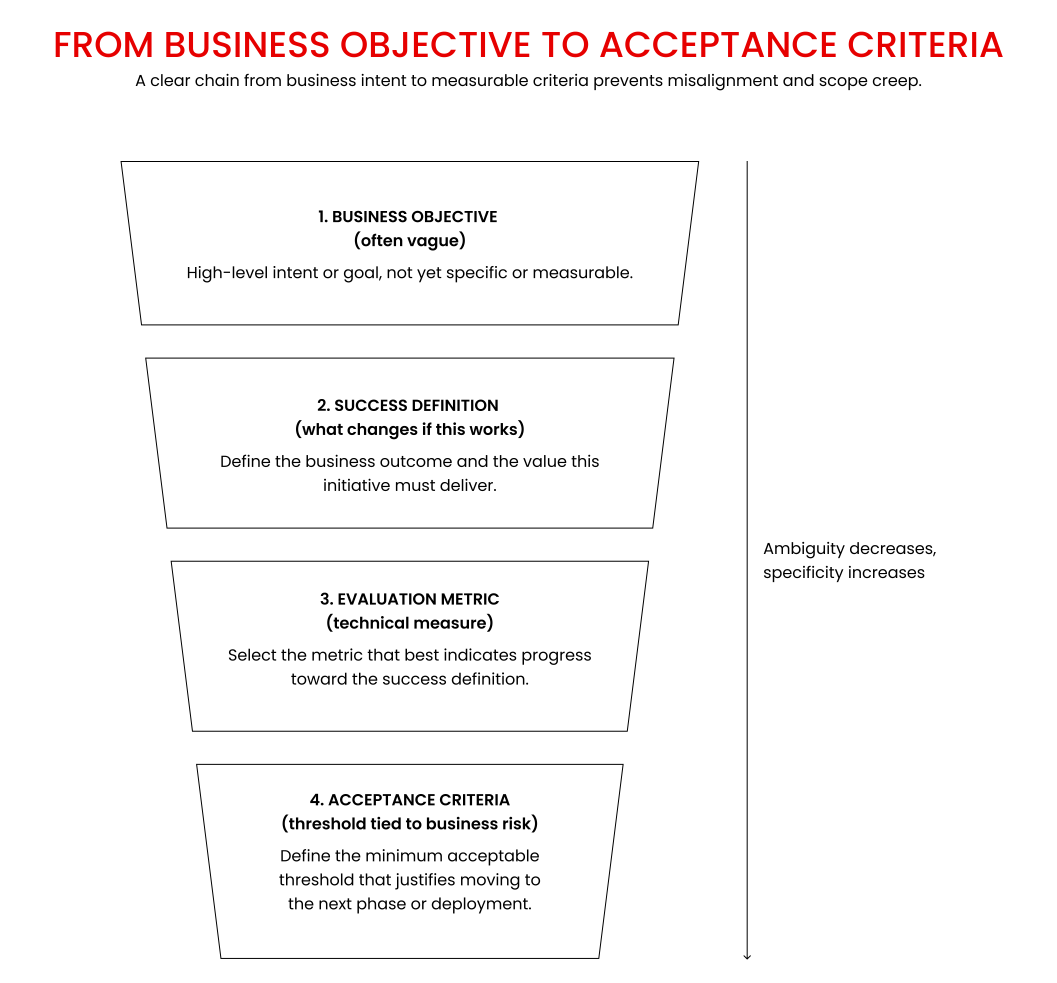
Figure 1: A business objective becomes manageable only when it is translated into measurable acceptance criteria and the consequences of error are understood.
But even those measures are not sufficient on their own. Because, a maintenance model that detects a developing problem three hours in advance may be technically impressive and operationally useless if the maintenance team needs two days to plan the intervention. Conversely, a model that produces an earlier but less precise signal may be valuable if engineers can use it as an additional source of evidence rather than as an automatic decision. We therefore evaluate technical performance and business performance together.
The question is not simply whether the model meets a statistical threshold. It is whether the resulting capability is good enough for the intended maintenance decision. AI solution is always made to support business requirement and therefore, it has to be always evaluated not just against technical achievements but also business requirements.
Experiments Can Produce Value
Failure means something different in an AI project. Suppose we test several approaches and none meets the required performance threshold. In a conventional software context, that may look like a development failure. In an AI project, it can be evidence that prevents a larger and more expensive failure later.
The experiments may show that the available data are insufficient, that a particular failure mode cannot currently be predicted with the available signals, that the target is unrealistic, that additional data are required or that another technical approach should be investigated. They may even show that AI is not the right answer to a particular maintenance problem at that time.
We should not celebrate every negative result. The work still needs time boxes, measurable objectives and decision gates. But discovering a wrong hypothesis early can be a successful project outcome if it prevents the organization from committing significantly more resources to an approach that cannot deliver the required value.
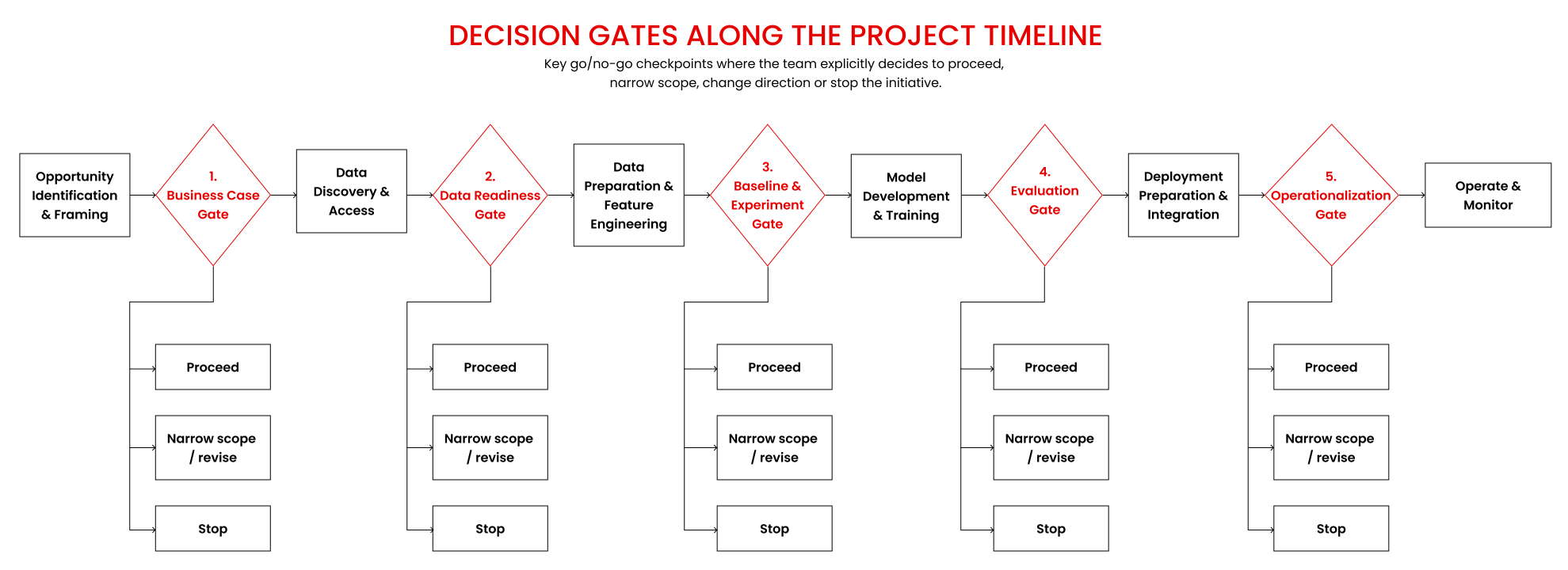
Figure 2: Not every AI project should move forward. The point of a gate is to make that decision explicit.
Iteration Is Controlled Learning
AI projects do not always move cleanly from one lifecycle phase to the next. A team may reach model evaluation and discover that performance is insufficient. If such thing happens, the next step may be to return to data preparation because additional examples are needed, to data understanding because the dataset is not representative, to model development because another approach should be tested, or even to business understanding because the original maintenance objective was framed incorrectly. That is why we have CPMAI framework and phases. We move back and forth if needed. That movement is not loss of control. It is controlled learning.
This is where the lifecycle described in From CRISP-DM to CPMAI: building an AI project lifecycle becomes particularly important. The project is not expected to move through six phases once and then declare success. The phases provide structure for managing the uncertainty and for deciding when movement backwards is justified. In our work, the important question is why we are moving back.
If the model fails because the historical maintenance events are poorly labeled, we do not simply ask the data science team to try another model. We address the underlying issue. If the model performs adequately in one operating regime but poorly in another, we investigate whether the scope, data or model needs to change. Again, if the business discovers that the required warning period is different from the one originally defined, we revisit the business objective and evaluation criteria.
The project manager’s responsibility is not to prevent iteration. It is to make the reason for iteration visible, assess its implications for scope, cost and schedule, and ensure that the next decision is based on evidence rather than optimism.
Risk Needs an Owner
AI projects bring the usual software risks that include unclear requirements, integration problems, security issues, cost pressure, infrastructure constraints and changing scope. They also bring risks tied to data and model behavior - biased or unrepresentative data, unreliable labels, unexpected outputs, model drift, data leakage, explainability limitations, dependencies on external models or services, variable inference costs and regulatory constraints.
For industrial AI, additional operational considerations can be important. A model may perform differently across equipment types, production conditions or sites. A sensor replacement may change the characteristics of incoming data. A change in maintenance policy may alter the historical relationship between observations and interventions.
Listing these risks is not enough because each risk needs an owner, an agreed control and a response if the risk becomes real. A dependency on a particular data source may require an alternative data source or a clearly defined fallback process. A model used to support maintenance decisions may require mandatory human review.
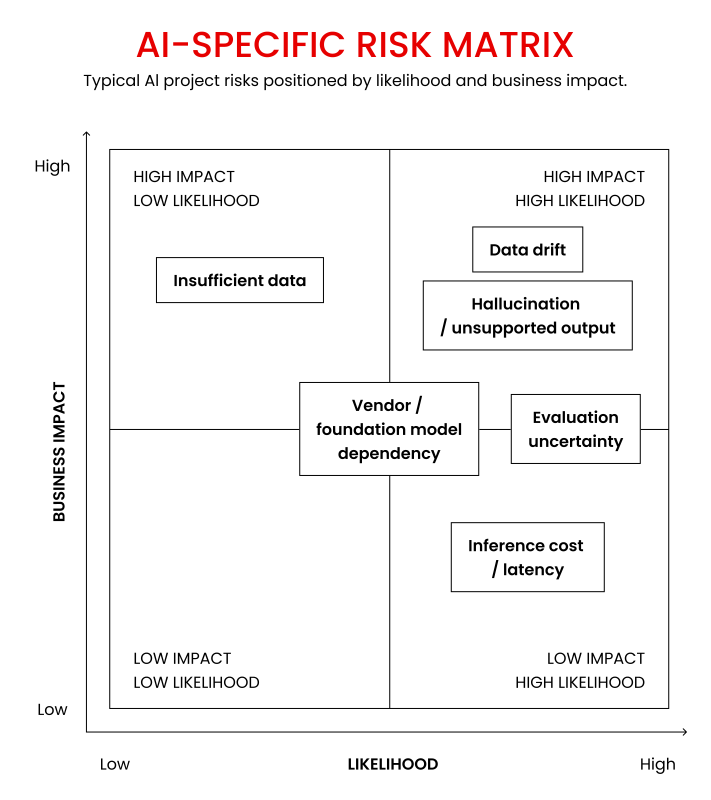
Figure 3: AI-specific risk matrix.
A high-cost AI workflow may need operational limits. A model whose performance varies significantly between equipment classes may need a restricted initial deployment rather than an organization-wide rollout. In practice, a risk register becomes useful only when it changes what the project does next. That is where project management meets the broader organizational operating model. The project itself may be well controlled, but AI also needs controls around ownership, decision-making and the way the capability is operated across the organization. For a broader discussion of this operating model, see Running AI under governance: An operating model for engineering organizations. Our project managers always have in mind that AI supports business and not for its own sake.
Human Oversight Is a Design Choice
Human-in-the-loop (HITL) is sometimes described as a temporary compromise on the path to full automation. In many industrial environments, it is simply the appropriate design choice. The relevant question is not whether every maintenance decision can be automated. It is which decisions can be supported automatically, which should require expert review, and which must remain entirely human. Introducing AI in the organization is not equal to excluding human from decisions and processes.
For proactive maintenance, an AI system may identify an unusual pattern and generate an alert. A maintenance engineer can then review the equipment history, current operating conditions and other available evidence before deciding whether an inspection or intervention is necessary. The AI system does not need to make the final maintenance decision to create value. This affects more than the user interface. It affects scope, workflow design, responsibilities, KPIs, operating cost, accountability and the data that the organization can learn from over time.
Operationalization Is Project Work
A model that performs well in a development environment is not yet a production AI capability. Operationalization may require data and other pipelines, model serving, integration with existing maintenance or asset management systems, authentication, infrastructure, monitoring, logging, versioning, automated testing, deployment processes, rollback mechanisms, security controls, cost monitoring and operational support.
This is where AI project management meets DevOps and MLOps. CI/CD practices support reliable software and model delivery, and MLOps helps manage data, model versions, evaluation and retraining workflows. Monitoring can reveal changes in incoming data or model performance before they become a larger operational problem. These practices need to be planned, funded, owned and governed as part of the project.
The same principle applies to the engineering work around the AI system. AI assistance may change how engineering work is performed, but it should not weaken the quality gates, human review or accountability that protect the resulting system. For a closer look at this engineering discipline, see Is “percentage of code written by AI” a good metric? What to measure instead
Deployment Starts Accountability
One of the defining characteristics of AI systems is that their performance can deteriorate even when the application code remains unchanged. A proactive maintenance model may encounter new equipment, changed operating conditions, different production regimes or changed sensor behavior. The code is unchanged, but the relationship between incoming data and the assumptions on which the model was developed may no longer be the same. This is the practical meaning of data drift and concept drift.
The operating loop therefore continues after the first production release. Production data feeds ongoing monitoring, and monitoring supports a regular performance evaluation against the criteria set earlier in the project. When that evaluation detects a meaningful change, we investigate its cause before deciding what to do about it - further data preparation, retraining the model, or changing the approach altogether. Whatever is chosen then goes through its own re-evaluation before it becomes a new deployment, not a repeat of the original one.
In our view, deployment is the point at which project accountability becomes operational accountability. The AI lifecycle continues after the first release. This is one of the reasons why operationalization should be considered during project planning rather than treated as the final technical step.
Adoption Changes Work
AI projects also change how people work, how decisions are made and where responsibility sits. In proactive maintenance, an AI capability may change the balance between scheduled maintenance and condition-based intervention. Maintenance engineers may spend less time responding to unexpected failures and more time investigating early warnings and prioritizing interventions.
That change needs to be understood by the people who will use the system. Technical delivery alone is not enough. The project may also need training, process redesign, communication, revised responsibilities, adoption measures and a feedback mechanism for the engineers and operational teams working with the system every day. A technically capable system can still fail if the people using it do not understand what its output means, when to challenge it or who is responsible for acting on it.
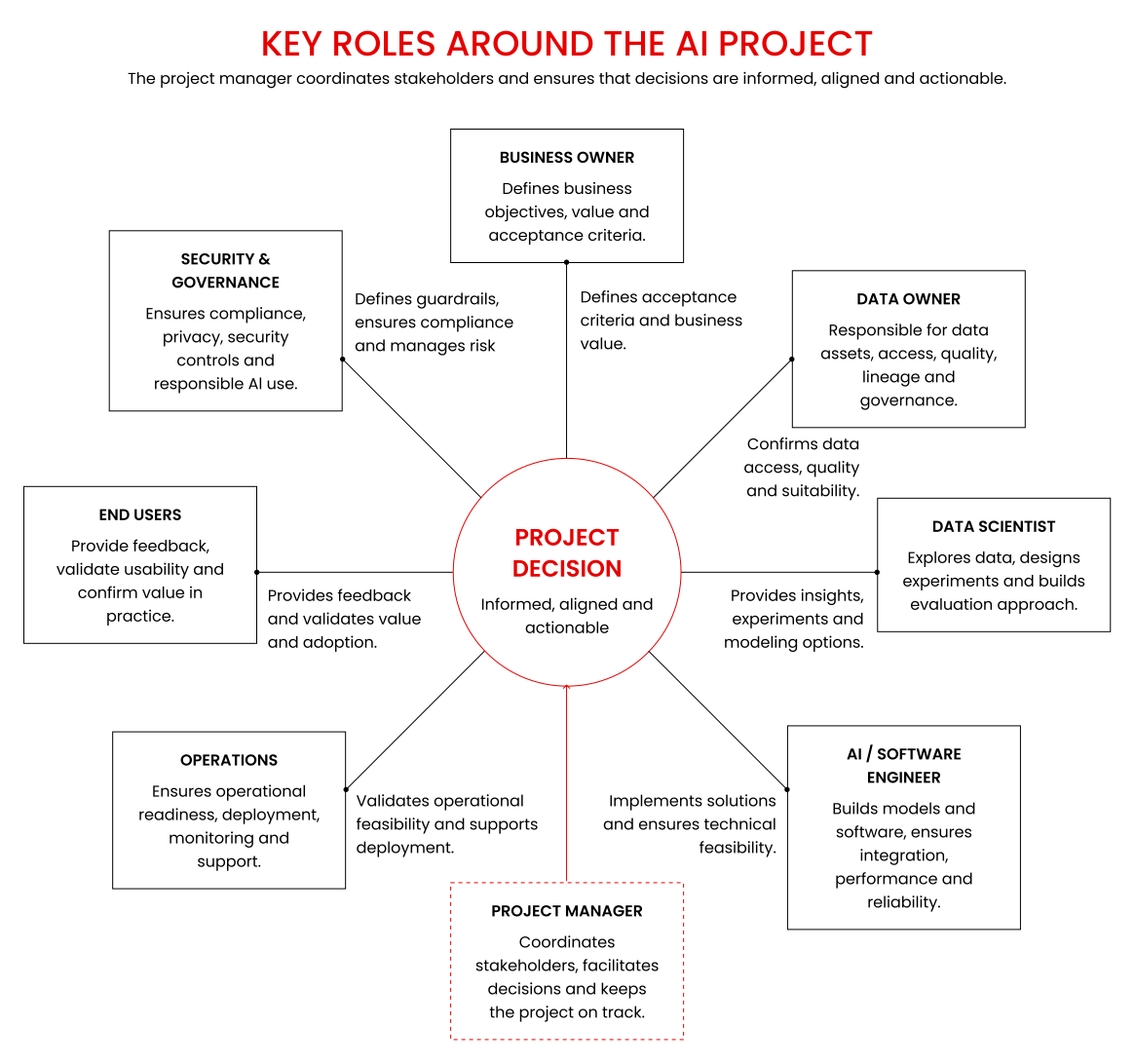
Figure 4: Key roles around AI project.
A Different Management Mindset
Taken together, these characteristics require a different project management mindset. The project still needs objectives, milestones, budgets, resources, responsibilities, risk management, governance and stakeholder communication. But it also needs hypotheses, experiments, baselines, data-readiness assessments, measurable performance targets, evaluation protocols, feasibility gates, controlled iteration and operational feedback loops. Differences are summarized in the table below.
| Conventional software project | AI project |
|---|---|
| Requirements define expected behavior | Requirements may include hypotheses and performance targets |
| Code is the primary implementation mechanism | Data, models, code and infrastructure jointly determine behavior |
| Testing asks whether the implementation meets requirements | Evaluation asks how well the system performs under defined conditions |
| Estimates can often follow requirements and architecture | Feasibility may need to be established through experimentation |
| Failure usually means implementation does not meet specification | A negative experiment can prevent larger future waste |
| Deployment is a major delivery milestone | Deployment begins the operational AI lifecycle |
| Monitoring focuses mainly on service health | Monitoring also tracks data and model behavior |
| Change management supports adoption | AI can directly change decision-making and human workflows |
The conclusion is not that AI projects require abandoning established project management or software engineering practices. Quite the opposite. They require those practices to be combined with a practical understanding of data, experimentation, model behavior and operational AI.
That is why the project manager becomes an integrator across business objectives, project controls, data, AI and ML, software engineering, DevOps and MLOps, operations and change management.
For an industrial company, the ultimate measure is not whether an AI model was successfully deployed. It is whether the resulting capability helps people make better maintenance decisions, earlier and with sufficient confidence to improve the operation.
Final Thoughts
Understanding AI before managing AI projects introduced the difference between conventional software development and an AI project through our industrial maintenance example.
Why AI project management is different examined why data, experimentation, uncertainty and model performance change the nature of the project.
From CRISP-DM to CPMAI: building an AI project lifecycle introduced CPMAI as a lifecycle for bringing those considerations together, from Business Understanding through Data Understanding, Data Preparation, Model Development, Model Evaluation and Model Operationalization.
This article has taken the next step - how those principles affect the practical management of scope, feasibility, data readiness, experimentation, acceptance, risk, human oversight and operationalization.
From an AI project to an organizational AI capability will look beyond the individual project and examine how organizations can turn the decision gates, roles, controls, operating routines and practical knowledge developed through AI delivery into a repeatable and sustainable AI capability.
Further reading
Red Black Tree delivers AI systems from feasibility to operation, under the project discipline described here. Get in touch to talk about your next AI initiative.
Frequently asked questions
How does scope management differ between a software project and an AI initiative?
In traditional software, scope is defined by functional requirements and deterministic features. In an AI initiative, scope must also encompass data dependencies, statistical performance thresholds, acceptable false-alarm rates, operational latency, and the specific decision-making workflows the system is designed to support.
Why should feasibility testing be governed as a separate project activity?
Feasibility experiments validate whether available data and selected modeling approaches can achieve the desired outcome before significant capital is committed. Governing feasibility as an explicit time-boxed activity prevents organizations from funding full-scale engineering for initiatives that cannot meet performance thresholds.
Why is Human-in-the-Loop (HITL) considered a permanent design choice rather than a temporary compromise?
In complex operational environments, AI outputs are probabilistic signals meant to augment human decision-making rather than fully replace it. Designing HITL into the workflow balances automation with domain expertise, managing business risks while building trust and ongoing operational accountability. It should be noted that AI-based decisions are probabilistic and never 100% accurate, meaning the cost of a wrong decision can be significant. HITL exists to mitigate this risk, ensuring that AI provides decision support while humans retain final ownership and accountability.
- ai
- project-management
- risk
- decision-gates
- human-in-the-loop
Senior AI Architect
Dejan Vujić, PhD EE, is a Senior AI Architect at Red Black Tree, a PMI-CPMAI-certified professional and a member of IIBA and IAPP, focused on enterprise AI project delivery, AI governance and operational AI systems.