From CRISP-DM to CPMAI: building an AI project lifecycle
AI project management / Part 3 of 5

Senior AI Architect
- Published
- Reading time
- 16 min read
CRISP-DM gave data work six named phases and a common language, but it does not manage a multidisciplinary enterprise initiative. CPMAI keeps the same shape and adds the project controls: business understanding, data understanding, data preparation, model development, model evaluation and model operationalization, each read as a decision rather than a deliverable. The predictive maintenance case runs through all six.
Understanding AI before managing AI projects established that AI systems are different from conventional software systems. Why AI project management is different explored the practical consequences - AI initiatives introduce uncertainty around data, feasibility, model performance and operational fit that must be managed deliberately.
The next question is practical. If an AI initiative involves both discovery and delivery, what lifecycle helps a team move from a business objective to an operational AI capability? There is no reason to discard established project management and software delivery practices. AI projects still require scope, stakeholders, budget, risk management, architecture, security, software engineering, testing, deployment and change management. Agile, Scrum, Kanban, DevOps, CI/CD, data engineering and MLOps all remain relevant.
The issue is that these disciplines, taken individually, do not describe the full journey of an AI initiative, from identifying a business decision that could be improved, through understanding the data and testing feasibility, to operating a model reliably in the real world. That is why AI project management has evolved by combining established practices with an AI-specific lifecycle.
From Delivery to Discovery and Delivery
Traditional project management provides the foundation for managing objectives, scope, stakeholders, resources, schedule, budget, risks, quality and delivery. Software development methodologies provide ways to translate requirements into working systems. Agile strengthened the emphasis on iteration, customer feedback, incremental delivery and adaptation to change. DevOps and CI/CD extended this by connecting development and operations through automated build, testing, integration and deployment practices.
Data science introduced another essential perspective. Unlike conventional software development, data science and Machine Learning depend on the availability, quality, context and representativeness of data. The team cannot assume that the required behavior can be implemented simply because the business objective is clear. That led to lifecycle approaches designed around data and analytical model development. One of the most influential is CRISP-DM - the Cross-Industry Standard Process for Data Mining.
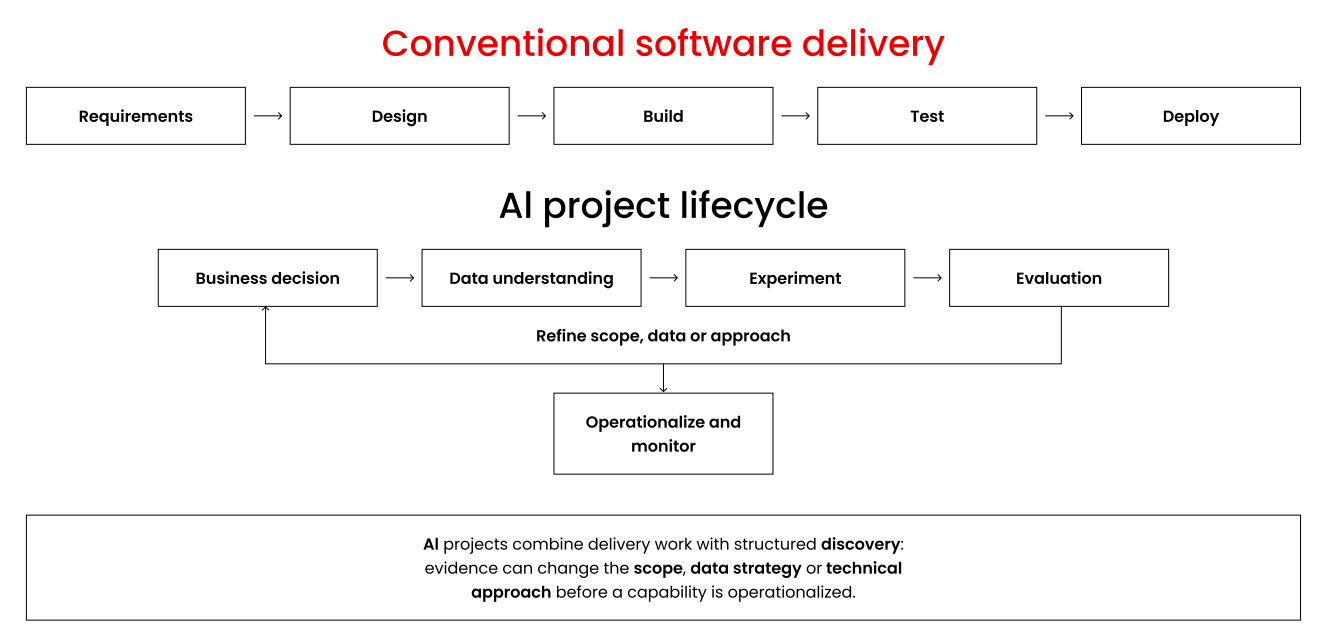
Figure 1: AI projects combine delivery work with structured discovery: evidence can change the scope, data strategy or technical approach before a capability is operationalized.
CRISP-DM: The Essential Foundation
CRISP-DM, originally published in 1999, introduced a six-phase lifecycle:
- Business Understanding;
- Data Understanding;
- Data Preparation;
- Modeling;
- Evaluation;
- Deployment.
Its importance is not simply that it created six named phases. CRISP-DM gave teams a common language for work that otherwise tends to become a collection of loosely connected data science activities. It starts with the business objective, makes the data an explicit part of the project and creates a natural path from data preparation through modeling and evaluation to deployment.
For a predictive maintenance initiative, we do not begin by asking which machine learning algorithm should be used. We first need to understand which assets matter, which failure modes create operational risk, how much warning time is useful and what maintenance decision the maintenance team should make when an alert is generated. Without those answers, the later technical work may be well executed and still produce a system with limited operational value.
CRISP-DM also makes it clear that data work is not a short preparation activity before the “real” development begins. Data must be explored, understood, prepared and evaluated throughout the lifecycle. Sensor readings, equipment history, alarms and maintenance records need to be understood before the team can make meaningful claims about what a model can predict. That remains one of its most important contributions. Even nowadays, data-related tasks take up much of the project time. CRISP-DM therefore provides a very good foundation for structuring the analytical work. But a foundation is not the whole building.
Where CRISP-DM Needs Support
The limitation becomes clearer when we look at the type of AI projects organizations are delivering today. A predictive maintenance system is not only a modeling exercise. It may involve SCADA or IoT data, asset management systems, CMMS or EAM records, production systems, reliability engineers, maintenance teams, software engineers, infrastructure, security, governance and operational support. For modern AI systems, that coordination surface can get wider still. Generative AI introduces foundation model selection, prompt and retrieval design, tool permissions, evaluation of non-deterministic outputs, cost and latency management, and new governance considerations, each with its own owner.
Someone must coordinate those participants. Someone must decide whether the data are ready before the next investment is made. Someone must manage experiments and decision gates. Someone must make sure that a technically successful model can be integrated into the maintenance process. And someone must remain accountable when the model is in production and its operating conditions change. This is where the distinction between a data-science lifecycle and an AI project lifecycle becomes important.
CRISP-DM describes the work needed to move from business understanding through data and modeling to deployment. It does not, by itself, provide a complete project management structure for a multidisciplinary enterprise initiative - team coordination, stakeholder structure and operational support all sit outside its scope. That does not make CRISP-DM obsolete. It means that it needs to be used as part of a broader delivery approach.
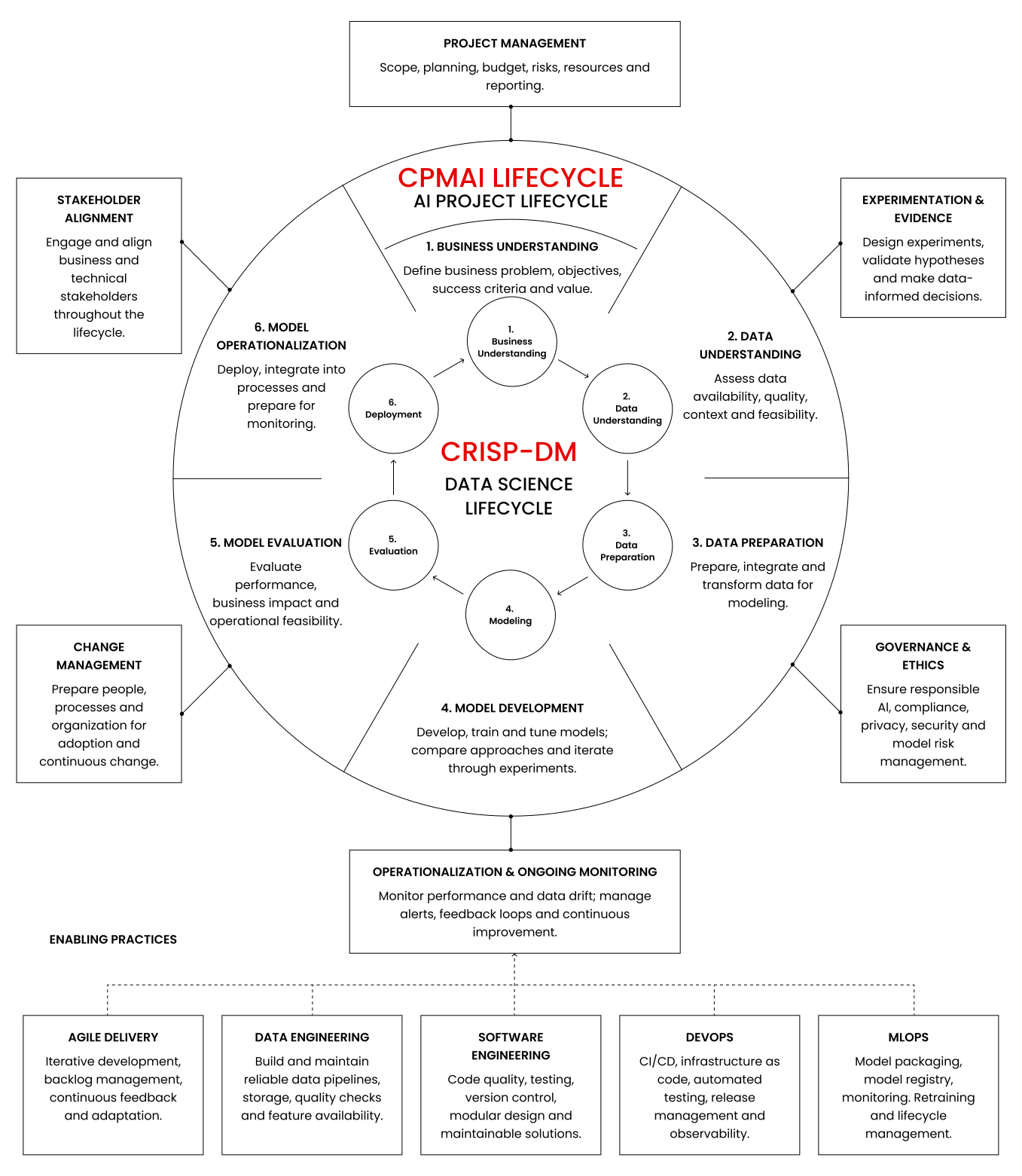
Figure 2: CRISP-DM structures the data-science work; CPMAI extends the lifecycle so that business value, project controls and operational AI are managed together.
CPMAI: An AI Project Lifecycle
As AI projects moved beyond analytical experiments and into operational systems, the project itself became broader. The question was no longer only how to develop a model from data. It became how to manage the complete journey from a business problem to an AI capability that people can use, operate, monitor and improve.
This is where CPMAI becomes useful. Cognitive Project Management for AI, or CPMAI, builds on established project-management practices, Agile approaches and data-science lifecycle thinking, including CRISP-DM. Its purpose is not to replace those practices, but to make the AI-specific project lifecycle more explicit.
The six primary phases are:
- Business Understanding;
- Data Understanding;
- Data Preparation;
- Model Development;
- Model Evaluation;
- Model Operationalization.
The names may look familiar to anyone who knows CRISP-DM. The practical difference is in how the lifecycle is used. CPMAI treats AI development not merely as data analysis or model building, but as a managed project that must repeatedly connect business value, data feasibility, experimentation, technical performance, operating constraints and ongoing improvement.
In our work, the lifecycle is not a compliance checklist. It keeps the questions and decisions that matter visible, so the team can deliberately revisit an earlier stage when business or technical evidence changes.
Business Understanding
Every AI initiative should begin with the business decision that needs to improve.
For predictive maintenance, this might mean reducing unplanned downtime for a specific class of critical assets. But that statement is only the start. We work with operational stakeholders to clarify:
- Which assets are critical and why;
- Which failure modes matter most;
- What the consequences of an unplanned failure are;
- How much warning time is required for maintenance teams to act;
- What action an alert should trigger or support;
- Whether the target is reduced downtime, improved availability, lower maintenance cost, reduced safety exposure or a combination of these;
- What a useful initial scope looks like.
This stage prevents the project from becoming a vague initiative to “apply AI to maintenance”. It gives the technical team a decision context. It gives the sponsor a basis for judging value. It gives the project manager a realistic starting point for scope, stakeholders, dependencies and acceptance criteria.
Data Understanding
Once the decision is clear, the team needs to establish whether the required data exist and what they represent. For predictive maintenance, this may include:
- Sensor readings from SCADA, IoT or condition monitoring systems;
- Operating history, usage hours and production context;
- Maintenance work orders and inspection records from CMMS or EAM platforms;
- Asset hierarchy, component history and replacement records;
- Alarm logs, fault codes and outage history;
- Supporting operational data from ERP, MES or production systems.
At this stage, we are not yet trying to prove that a model will work. We are establishing whether the data can support a credible experiment. That means asking difficult questions early:
- Are asset identifiers consistent across systems?
- Can sensor data be aligned with maintenance events and operating conditions?
- Are historical records sufficiently detailed to distinguish routine servicing from actual degradation or failure?
- Are the relevant events captured consistently across sites?
- Do data gaps, changed sensor calibrations or changes in maintenance policy affect interpretation?
- Is there enough history to represent both normal operation and meaningful failure conditions?
- Can the organization continue to collect and govern the necessary data after the solution is deployed?
In many projects, these questions reveal the actual critical path. A capable data science team cannot compensate for records that are inaccessible, misaligned or unable to represent the event the business expects the model to predict. That is why we do not treat data access as proof of data readiness.
Data Preparation
Data preparation turns available data into material that can be used reliably for model development and evaluation. For an industrial maintenance use case, this may involve cleaning sensor streams, aligning time windows, handling missing values, standardizing asset identifiers, integrating maintenance records, defining target events, creating training and test datasets, and preparing pipelines that can later support production use. This stage often shows that data can be technically available and still not be ready for use.
A maintenance work order may state that a component was replaced without explaining whether it failed, was approaching failure or was replaced during a planned service window. A sensor may record values at intervals that do not align with the operational events being investigated. Different sites may use different codes for the same intervention.
These are not minor data cleaning issues. They influence what the model can learn and what the project can reasonably claim. We use data preparation to create traceable datasets, not merely to make files acceptable to a modeling tool. The team should be able to explain what each target represents, how it was constructed, what limitations it carries and whether it reflects the decision the system is meant to support.
Model Development
Model development is the phase most people associate with AI. It is important, but it is rarely the first point at which a project succeeds or fails. For predictive maintenance, the appropriate approach may involve anomaly detection, supervised classification, time-series forecasting, estimation of parts’ remaining useful life or a combination of methods. The correct choice depends on the business objective, the data available, the rarity and quality of failure events, the required warning lead time and the way the result will be used operationally.
In our work, we have found that starting with the most complex model available is often a poor way to start an AI project. We begin with a baseline and a hypothesis. A simple threshold-based alarm, current preventive maintenance schedule or straightforward statistical approach may be the right reference point. More advanced models must demonstrate that they improve decisions enough to justify their additional complexity, cost and operating risk. We always start with models that can explain results, key inputs and their influence. That is how we understand domain-specific problems and relate them to business requirements.
Different approaches are then evaluated against defined conditions. The team may find that anomaly detection provides early signals but creates too many false alerts. It may find that supervised learning works for one asset class but lacks enough labeled examples for another. It may find that the best initial design combines model alerts with expert review. That is not a detour from delivery. It is the work that determines what can responsibly be delivered.
Model Evaluation
Model evaluation asks whether the solution is good enough for the intended business purpose, not simply whether the model scores well on a technical metric. For predictive maintenance, we evaluate the model in the context of operational decisions:
- Does it identify meaningful early signs of failure?
- How often does it miss a failure that the organization needed to detect?
- How many false alerts does it generate?
- How much warning time does it provide?
- Does performance differ across asset types, sites or operating regimes?
- Is the output understandable enough for maintenance engineers to investigate and act on?
- Does the solution improve availability, maintenance planning or downtime outcomes relative to the baseline?
- Where should human review remain part of the workflow?
A model can be statistically imperfect and still be useful if it supports a well-designed human-in-the-loop (HITL) process. Conversely, a technically strong model may be unsuitable if it creates more alerts than operations can absorb or fails in the conditions that matter most.
We therefore treat evaluation as a decision gate, not a final technical report. The output should make it possible to decide whether to proceed, adjust scope, improve the data, change the approach, retain additional human controls or stop.
Model Operationalization
Operationalization moves the AI capability into the environment in which people and processes must rely on it. For our predictive maintenance use case, this can include integrating model output with CMMS or EAM workflows, presenting alerts in an operational dashboard, defining engineer review and escalation paths, establishing approval rules for work orders, securing data flows, managing model versions and monitoring performance after release. This is where AI project management connects strongly with software engineering, DevOps, MLOps, data engineering, cybersecurity, governance and change management.
Operationalization is not simply model deployment. A model can run in production and still fail to create value if alerts do not reach the right people, arrive too late, cannot be understood, do not fit into the maintenance workflow or are not trusted by those expected to act. We design the operating model alongside the model itself. The questions include who receives the alert, what evidence they see, who can decide to intervene, how the outcome is recorded and how that outcome feeds future learning. This is how a technically sound model becomes an operational capability. In practice, deployment is not the end of the engineering effort - it is the moment when model governance and operational monitoring take over to ensure the solution evolves alongside changing business conditions.
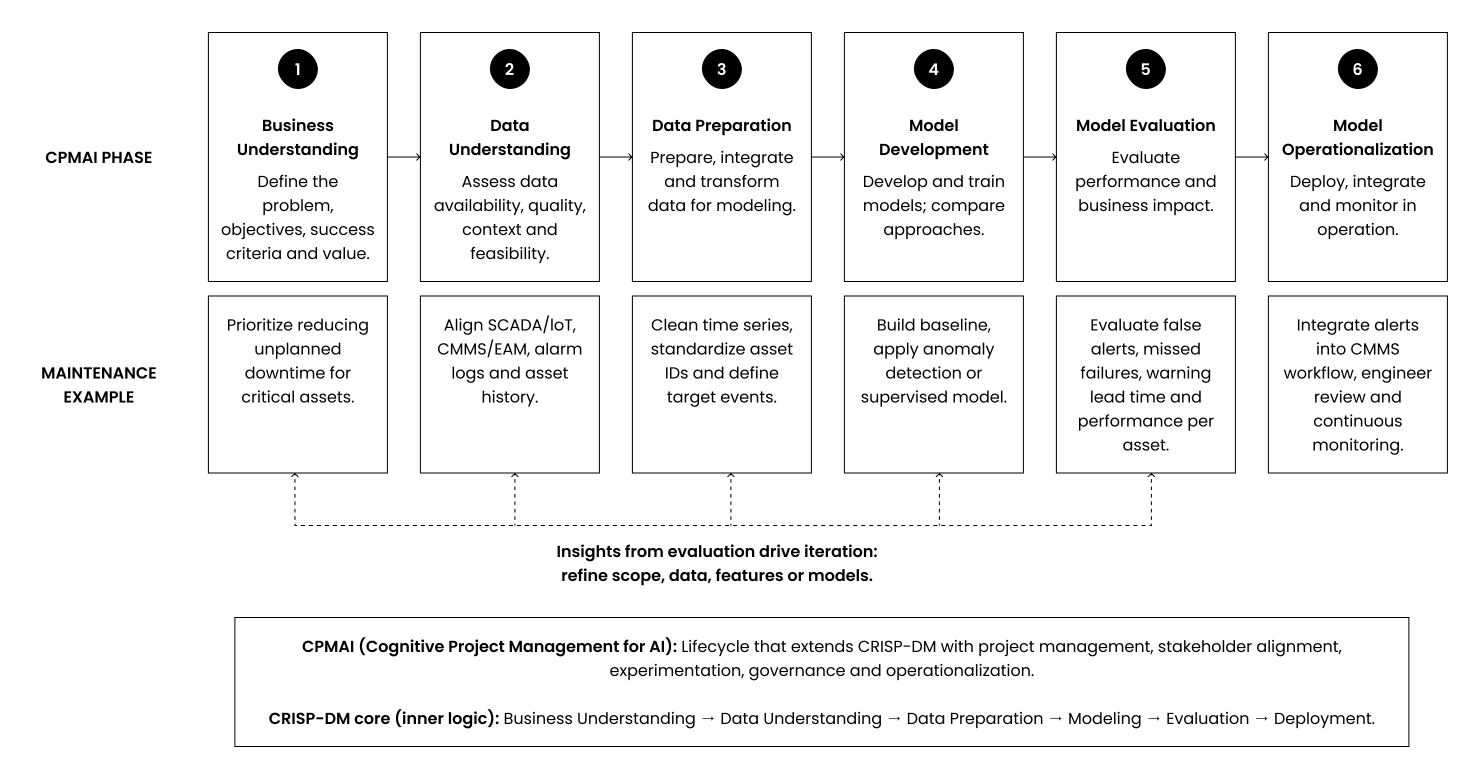
Figure 3: The lifecycle becomes useful when every phase is translated into a decision and a concrete operational activity.
CPMAI Alongside Agile, DevOps and MLOps
CPMAI should not be understood as a replacement for established delivery practices. Each discipline contributes something different, as presented in the following table.
| Discipline | Primary contribution |
|---|---|
| Project management | Governs objectives, scope, stakeholders, risks, budget and delivery |
| CPMAI | Provides the AI-specific lifecycle from business understanding to operationalization |
| Agile, Scrum and Kanban | Organize iterative delivery and prioritized work |
| Data engineering and data management | Make data accessible, reliable, governed and usable |
| AI, ML, LLM, computer vision and other methods | Provide the technical intelligence for the use case |
| Software engineering | Builds the surrounding application, integration and user experience |
| DevOps, MLOps and CI/CD | Automate, deploy, monitor and maintain the operational system |
| Change management | Supports adoption, process change and sustained use |
These are complementary capabilities, not competing methodologies. The project needs them at different points and at different levels. We use CPMAI to keep the lifecycle visible. We use Agile to organize delivery. We use data engineering and software engineering to build reliable systems. We use MLOps and operational controls to ensure the capability remains reliable after deployment. The value lies in connecting these disciplines around the business decision the AI system is meant to improve.
A Lifecycle That Learns
A simplified software lifecycle is often described as a straight progression from requirements to design, development, testing and deployment. AI project work rarely follows that same straight line because stages loop back as evidence accumulates. We treat that non-linearity as part of the project design rather than as an exception to it. The CPMAI lifecycle gives us a practical structure for doing that, moving through business understanding, data understanding, data preparation, model development, model evaluation and model operationalization. The important feature is not the six stages themselves, but how we move between them as evidence changes. Evaluation can send us back to data preparation. A data quality issue may require us to revisit the target definition. Operational monitoring can lead to new data collection, adjusted thresholds or another development cycle.
Our predictive maintenance model may work well for a particular compressor or turbine type but perform poorly after sensor replacement or under a different operating regime. The appropriate response may be to investigate the changed data, narrow the deployment scope, collect additional examples, recalibrate thresholds or develop a separate model. This is not an indication of poor control. This is what responsible control looks like when the system’s future behavior must be demonstrated under real operating conditions rather than fully specified in advance. The lifecycle gives the team a structured way to learn what is possible, what is not possible and what needs to change before the organization commits significant resources to the wrong solution.
What This Changes for Project Leadership
For the project manager, an AI lifecycle changes the focus of leadership. The role is not only to maintain a plan, coordinate tasks and report progress. It is to make uncertainty visible, structure the work that reduces it and ensure that evidence leads to deliberate project decisions. That requires consistent involvement from business sponsors, operational domain experts, data owners, data scientists, AI and software engineers, security and governance functions, and the teams that will use and support the system.
We use the lifecycle to keep several questions active throughout the initiative:
- Are we still solving the right business problem?
- Do the data support the capability we are trying to build?
- Is the current approach materially better than the baseline?
- Does the model work well enough under the conditions that matter?
- Can people use its output safely and effectively?
- Can the organization operate, monitor and improve the capability over time?
When those questions are addressed continuously rather than at the end, the project is more likely to create a capability that survives contact with real operations.
Further reading
- PMI, Cognitive Project Management for AI (CPMAI)
- Martin Zinkevich, Google, Rules of Machine Learning: Best Practices for ML Engineering
- Khalid Salama et al. Google Cloud, The Practitioners Guide to MLOps
- NIST. Artificial Intelligence Risk Management Framework (AI RMF 1.0)
Red Black Tree delivers AI systems from feasibility to operation, under the project discipline described here. Get in touch to talk about your next AI initiative.
Frequently asked questions
Why is CRISP-DM no longer sufficient on its own for enterprise AI initiatives?
CRISP-DM provides an excellent foundation for data science and modeling, but it was not designed to manage modern multidisciplinary enterprise environments. It lacks native coverage for cross-team governance, operational accountability, MLOps integration, continuous drift monitoring and organizational change management. CRISP-DM was written when modern AI projects didn't exist.
How does CPMAI extend data science lifecycles into operational capabilities?
CPMAI builds upon CRISP-DM by embedding project management controls, stakeholder alignment, explicit risk management, and operationalization gates into every phase. It treats AI delivery as a business-driven lifecycle where technical evaluation directly dictates deployment feasibility and ongoing governance.
What happens when an operationalized AI model begins to encounter new data conditions?
Operationalization triggers a continuous learning feedback loop. When evaluation or production monitoring reveals a drop in performance or data drift, the CPMAI lifecycle guides controlled iteration back to data preparation or model development to revalidate thresholds before re-deploying. That is how data drift and model drift are resolved.
- ai
- project-management
- cpmai
- crisp-dm
- mlops
Senior AI Architect
Dejan Vujić, PhD EE, is a Senior AI Architect at Red Black Tree, a PMI-CPMAI-certified professional and a member of IIBA and IAPP, focused on enterprise AI project delivery, AI governance and operational AI systems.