From an AI project to an organizational AI capability
AI project management / Part 5 of 5

Senior AI Architect
- Published
- Reading time
- 11 min read
The first successful AI project delivers a system and teaches the organization how its data, stakeholders, evaluation and operations actually behave. Capability is what survives the project: reusable foundations, proportional governance, an operating model with named owners, and a learning cycle that makes the next use case cheaper to start. Count what the organization can repeat, not how many models it runs.
The previous four parts have looked at AI project management from different angles - why AI projects differ from conventional software projects, how data and experimentation affect project control, how CPMAI provides a practical lifecycle, and what project management looks like when uncertainty, evaluation, risk and operationalization become part of the work. There is one question left - what happens after an organization has successfully delivered its first AI project?
For us, this is where the discussion becomes more interesting. The objective is not simply to deliver one successful AI system. The objective is to develop the organizational capability to identify, deliver, operate and improve AI systems repeatedly. That is a different level of maturity.
From One Successful Project to a Repeatable Capability
Consider the predictive maintenance initiative we have used throughout this series. The initial objective may be clear enough - reduce unplanned downtime of critical industrial equipment by using operational and maintenance data to identify early signs of failure.
The project may successfully connect SCADA and IoT data with CMMS or EAM records, develop and evaluate an appropriate approach, integrate alerts into the maintenance workflow and establish monitoring and human review.
At that point, the project has delivered something valuable but the organization has also learned something else. It has learned how its operational data are structured, where the important gaps are, how maintenance events are recorded, which stakeholders need to be involved, what evaluation looks like, how engineers interact with model outputs and what is required to operate the system reliably.
That knowledge should not disappear when the project ends. It becomes part of the organization’s AI capability. This is the value that we receive from each of our AI-related projects.
The next predictive maintenance initiative should not have to rediscover everything from the beginning. The organization should be able to reuse the architecture, engineering practices, evaluation methods, governance controls and project management experience developed during the first implementation. This is the transition from an AI project to an organizational capability.
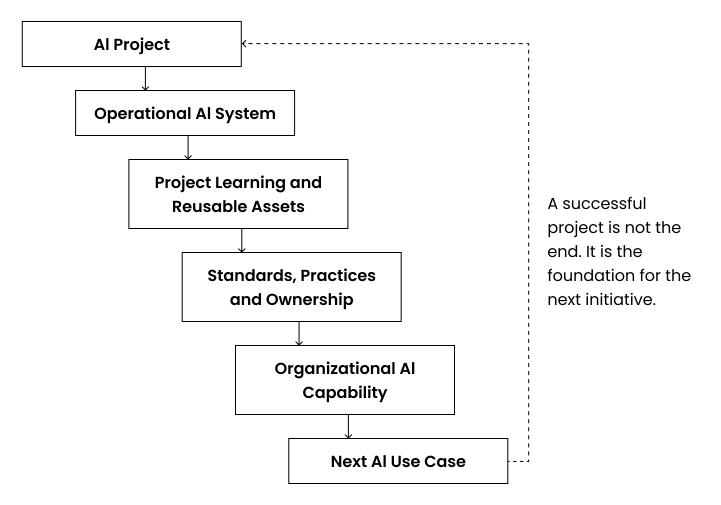
Figure 1: An AI project creates value twice: first through the operational system it delivers, and then through the knowledge, practices and foundations that can be reused by future initiatives.
The Project Creates More Than a System
A successful AI project produces an operational system, but it can also create organizational assets around that system that may include:
- Reusable data pipelines and integration patterns;
- Established data ownership and access processes;
- Evaluation and acceptance standards;
- Model development and deployment practices;
- Monitoring and operational procedures;
- Governance and risk controls;
- Human review and escalation processes;
- Architectural patterns;
- Experience with AI infrastructure and operating costs; and perhaps most importantly
- People who understand how AI works in the context of the organization.
The value of these assets increases when they can be reused. For example, once an industrial organization has established reliable connections between equipment data, asset history and maintenance records, the same foundations may support additional equipment classes or other operational use cases. The organization does not start again from zero, but from what it has already learned.
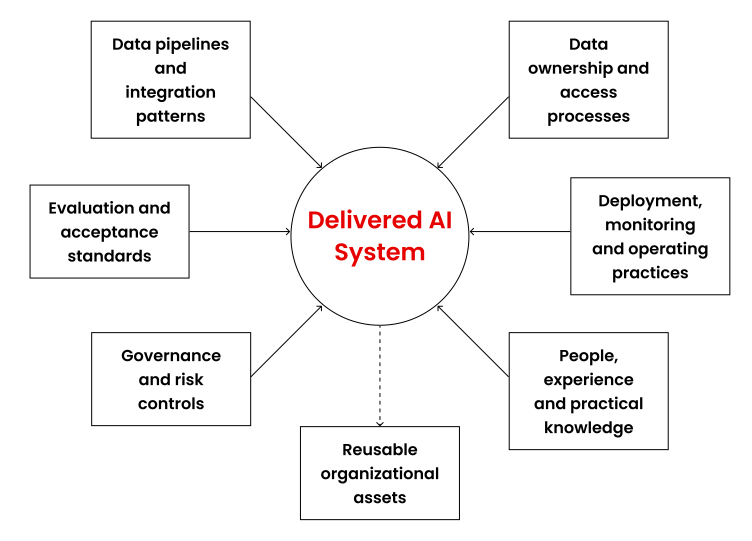
Figure 2: A successful AI project should leave behind more than a deployed system: it should create reusable data, engineering, governance and operational assets.
The Organizational Layer
The organizational layer is where AI project management connects with organizational design. A single project can have its own business owner, data owner, technical team, governance process and operational stakeholders. An organization running many AI initiatives needs something more systematic. It needs to decide how AI opportunities are identified and prioritized, how projects are assessed before significant investment, which architectural and security standards apply, how models are evaluated, who owns systems after deployment and how performance is monitored over time.
These decisions should not be reinvented for every project. The organization needs a common way of working while still allowing individual AI projects to adapt to their specific business problems. This does not mean creating a large central bureaucracy around AI. The objective is to establish enough structure that teams can move faster without repeatedly solving the same organizational problems.
From Project Knowledge to Organizational Knowledge
One of the less visible outcomes of an AI project is the knowledge accumulated during delivery. The team learns which data sources are reliable, where operational records contain ambiguity, which approaches work for particular classes of problems, where human review is necessary and what users actually need from the system rather than what was assumed at the beginning of the project. That knowledge should become accessible to the next project. Otherwise, the organization pays for the same learning repeatedly.
In our work, we therefore see AI delivery as both implementation and learning. The project produces a system, but it should also leave behind patterns, decisions and practical knowledge that make the next initiative more predictable. This is one of the clearest differences between an organization that has completed an AI project and one that is developing an AI capability.
Capability Requires Engineering Foundations and Governance
Organizational AI capability is not created by project management alone. The engineering foundations matter. An organization that wants to operate multiple AI systems needs reliable data engineering, software engineering, cloud or on-premise infrastructure, security, model deployment, monitoring and operational support.
The exact architecture will vary. A predictive maintenance solution may require industrial data platforms, time-series processing, integration with CMMS or EAM systems, model serving and operational dashboards. Another AI use case may require a completely different architecture. The principle remains the same - AI capability is built on engineering capability. This is also why AI-assisted engineering needs to remain connected to established engineering discipline. Faster development is useful only when quality, security, testing, review and accountability remain intact.
The same applies to governance. As the number of AI systems increases, the organization needs to know which systems exist, what they are used for, what data they depend on, who owns them and what controls apply. Risk cannot be managed effectively if every project uses completely different definitions and processes. At the same time, governance should not become a reason for every AI initiative to follow the same heavyweight process regardless of its risk. A predictive maintenance model used to recommend an inspection does not necessarily require the same controls as an AI system making decisions with direct financial or safety consequences. The organizational capability therefore needs proportionality. Common principles and controls should exist, while their application should reflect the actual risk of the system.
The Operating Model Matters
Once several AI systems are operating, another question becomes unavoidable - who is responsible for them? The project team may have built the first version, but production systems need owners after the project ends. Someone must be responsible for:
- Operational performance;
- Model and data monitoring;
- Incident response;
- Model changes and revalidation;
- Infrastructure and cost;
- User feedback;
- Security;
- Governance;
- Eventual retirement or replacement.
This is the operating model behind the AI capability. Without clear ownership, systems gradually become difficult to maintain. The original project team moves on, operational knowledge becomes fragmented and nobody has a complete view of what the system is expected to do. A production AI system therefore needs an organizational home.
Measuring the Capability
An organization should also be able to distinguish activity from capability. Counting the number of AI projects, models or experiments does not demonstrate that an organization has become better at using AI. More meaningful questions are:
- Can the organization identify valuable AI opportunities?
- Can it determine feasibility before committing significant resources?
- Can it obtain and prepare the required data?
- Can it evaluate AI systems consistently?
- Can it deploy them into real operational environments?
- Can it monitor their performance?
- Can it manage their risks?
- Can it support users?
- Can it learn from one project and apply that knowledge to the next?
These questions describe capability much better than the number of models in production. The objective is not to maximize the number of AI systems. It is to develop the ability to deliver the right AI systems and operate them successfully.
What This Means for the AI Project Manager
This broader view also changes the role of the AI project manager. The project manager remains responsible for project objectives, scope, stakeholders, risks, resources and delivery. But the project also sits within a larger organizational system. The project manager therefore needs to understand where the project depends on organizational capabilities and where the project itself can strengthen those capabilities.
For example, if the predictive maintenance project discovers that asset identifiers are inconsistent across operational systems, solving that issue may be necessary for the project. But the solution may also improve the data foundation for future initiatives. If the project establishes a useful model-evaluation process, that process may become a standard for subsequent AI projects.
If the project develops an effective human review workflow, that experience can inform other AI-assisted operational processes. The project therefore contributes to the organization while the organization provides the foundations that make the project possible. This relationship is important. AI capability is not something that exists above projects. It is built through projects and then made reusable across projects.
From Delivery to Organizational Learning
At this point, the AI lifecycle becomes larger than the lifecycle of an individual model. The project lifecycle may look like this - a business problem leads to data, the data supports an experiment, the experiment is evaluated, and what survives evaluation moves into operationalization.
The organizational learning cycle is broader. A use case becomes a project, the project generates operational experience, that experience turns into lessons learned, and those lessons, when captured properly, become a reusable capability that shapes how the next use case gets started.
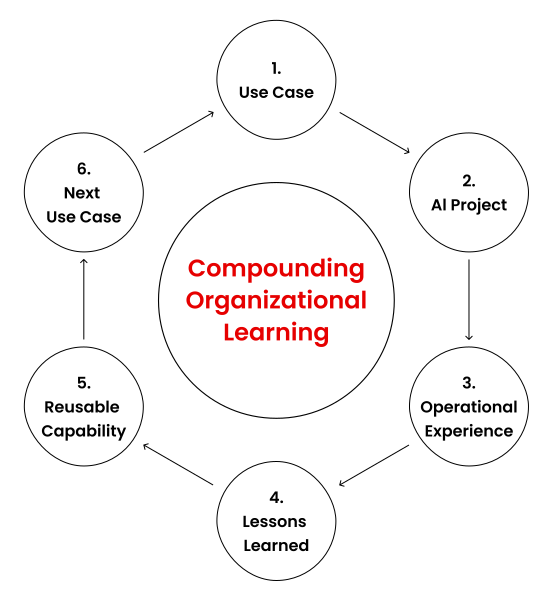
Figure 3: Organizational AI capability grows when delivery experience is deliberately captured, reused and improved in the next initiative.
The second cycle is where an organization begins to compound its experience. Each successful project should make the next project easier to understand, estimate, govern, engineer and operate. Each unsuccessful experiment should also contribute something, provided the organization captures what was learned and uses it to improve future decisions. This is how AI capability develops over time.
What We Mean by AI Capability
For us, organizational AI capability is therefore not simply a collection of models, tools or platforms. It is the ability to repeatedly move from a real business problem to an AI-enabled operational capability, while managing the data, technology, people, risks and organizational change required along the way.
The technology will continue to change and models will improve. New foundation models will appear while infrastructure will evolve. Engineering practices constantly change. The organizational capability needs to be able to absorb those changes without rebuilding the entire approach from scratch. That is the more durable objective.
Conclusion
The central lesson of this five-part series is not that AI requires an entirely different form of project management. It is that AI requires project management to be connected more closely with the realities of data, experimentation, model behavior, engineering and operations.
We have looked at why AI projects differ from conventional software projects, how those differences affect project management, how CPMAI provides a practical lifecycle, and how project managers can work with uncertainty, evidence, risk and operational accountability.
The final step is to look beyond the individual project. A successful AI project should leave the organization with more than a deployed model. It should leave behind knowledge, engineering foundations, operating practices, governance controls and people who know how to work with AI in the context of the business. That is what turns a successful project into an organizational capability.
For us, this is also the practical value of the approach described throughout these five parts. The disciplines are different, but they are not isolated - business understanding, data, AI and ML, engineering, project management, governance and operations have to work together.
When they do, AI becomes more than an experiment or a collection of models. It becomes a capability the organization can use, manage and improve over time. And that is ultimately what we should expect from an AI project: not simply a model that works, but an organization that knows how to make AI work.
Further reading
- NIST AI Risk Management Framework (AI RMF 1.0)
- ISO/IEC 42001: Artificial Intelligence Management System
- PMI, CPMAI
Red Black Tree delivers AI systems from feasibility to operation, under the project discipline described here. Get in touch to talk about your next AI initiative.
Frequently asked questions
What is the difference between completing an AI project and building an organizational AI capability?
Completing an AI project delivers a single operational system for a specific use case. Building an organizational AI capability means establishing reusable data pipelines, architectural patterns, governance controls, and operational experience so that subsequent AI initiatives can be delivered faster, with lower risk, and at a lower cost.
Who owns an AI system once the project phase ends and it is in production?
Production AI systems require a clear operational home. An operational owner, working alongside IT, data engineering, and business stakeholders, must take responsibility for monitoring model performance, handling incidents, managing data drift, ensuring security compliance, and governing retraining cycles.
How should an organization measure its true AI maturity?
True maturity is not measured by the number of models in production or active experiments. It is measured by the organization's ability to repeatedly identify high-value opportunities, assess feasibility before investing, consistently evaluate risk, deploy into operational workflows, and systematically apply lessons learned to future projects. Ultimately, true maturity fosters a culture of confidence, trust, and operational clarity across the entire AI ecosystem, ensuring that AI is no longer treated as an uncertain experiment but as a dependable business capability.
- ai
- project-management
- ai-governance
- operating-model
- organizational-capability
Senior AI Architect
Dejan Vujić, PhD EE, is a Senior AI Architect at Red Black Tree, a PMI-CPMAI-certified professional and a member of IIBA and IAPP, focused on enterprise AI project delivery, AI governance and operational AI systems.