
Why AI project management is different
AI project management / Part 2 of 5

Senior AI Architect
- Published
- Reading time
- 12 min read
An AI project carries requirements and hypotheses. A hypothesis needs evidence, so experiments become project activities with objectives, evaluation methods and stopping conditions. Data readiness is assessed as feasibility, a baseline keeps the model honest, and acceptance criteria are written in terms of what a false alarm and a missed event cost. Agile organizes the iteration; it does not manage the uncertainty.
Understanding AI before managing AI projects established an important distinction - an AI project is not simply a software project with an AI model added to it. The practical consequence is more important than the definition itself. If the nature of the work is different, then the way we plan, estimate, control and evaluate the project must also change. This does not mean abandoning software engineering, Agile delivery or established project-management practices. It means recognizing where they are sufficient and where AI introduces additional uncertainty that must be managed explicitly.
In our approach, this distinction starts with one question - what does the project need to discover before it can confidently commit to a solution?
From Requirement to Evidence
In conventional software development, requirements usually describe behavior that the team is expected to implement. Once the requirements, architecture and constraints are sufficiently understood, the team can estimate the work required to build and test the system. AI projects can contain the same type of requirements but they can also contain something fundamentally different - hypotheses about what the system can achieve.
A business stakeholder may require a model to detect fraud, forecast demand, classify documents, recommend products or predict equipment failures. The desired business outcome may be clear. The technical feasibility of achieving it at the required level of performance may not be. We therefore distinguish between a requirement that describes known system behavior and a hypothesis that requires evidence.
A requirement tells the team what the system is expected to do. A hypothesis states what the team believes can be achieved and must be demonstrated. That distinction changes planning. Instead of assuming that implementation is the next step, we may first need to establish whether the data, target definition, modeling approach and operating conditions can support the intended capability.
This is where experimentation becomes part of project management. An experiment in an AI project is not an uncontrolled research exercise. We treat it as a structured project activity with an objective, a defined evaluation method, a decision to be informed and, where possible, a clear stopping condition. Typical early experiments may include:
- Testing whether available data contains sufficient information to support the business objective;
- Establishing a simple baseline against which more complex approaches can be compared;
- Comparing alternative modeling or AI approaches;
- Measuring the impact of data quality and missing information;
- Testing performance on previously unseen data and relevant operating conditions;
- Determining the consequences of false positives and false negatives;
- Evaluating whether additional data would improve the result;
- Testing whether the proposed capability can operate within acceptable cost, latency and reliability limits.
The important point is that the experiment produces evidence for a project decision. The result may support the original hypothesis. It may show that the target is achievable only under narrower conditions. It may show that additional data is required. It may demonstrate that a simpler approach is sufficient. It may even show that the proposed AI solution should not proceed. So, a failed experiment can therefore be a successful project outcome when it prevents the organization from committing significant resources to an approach that cannot meet its objectives.
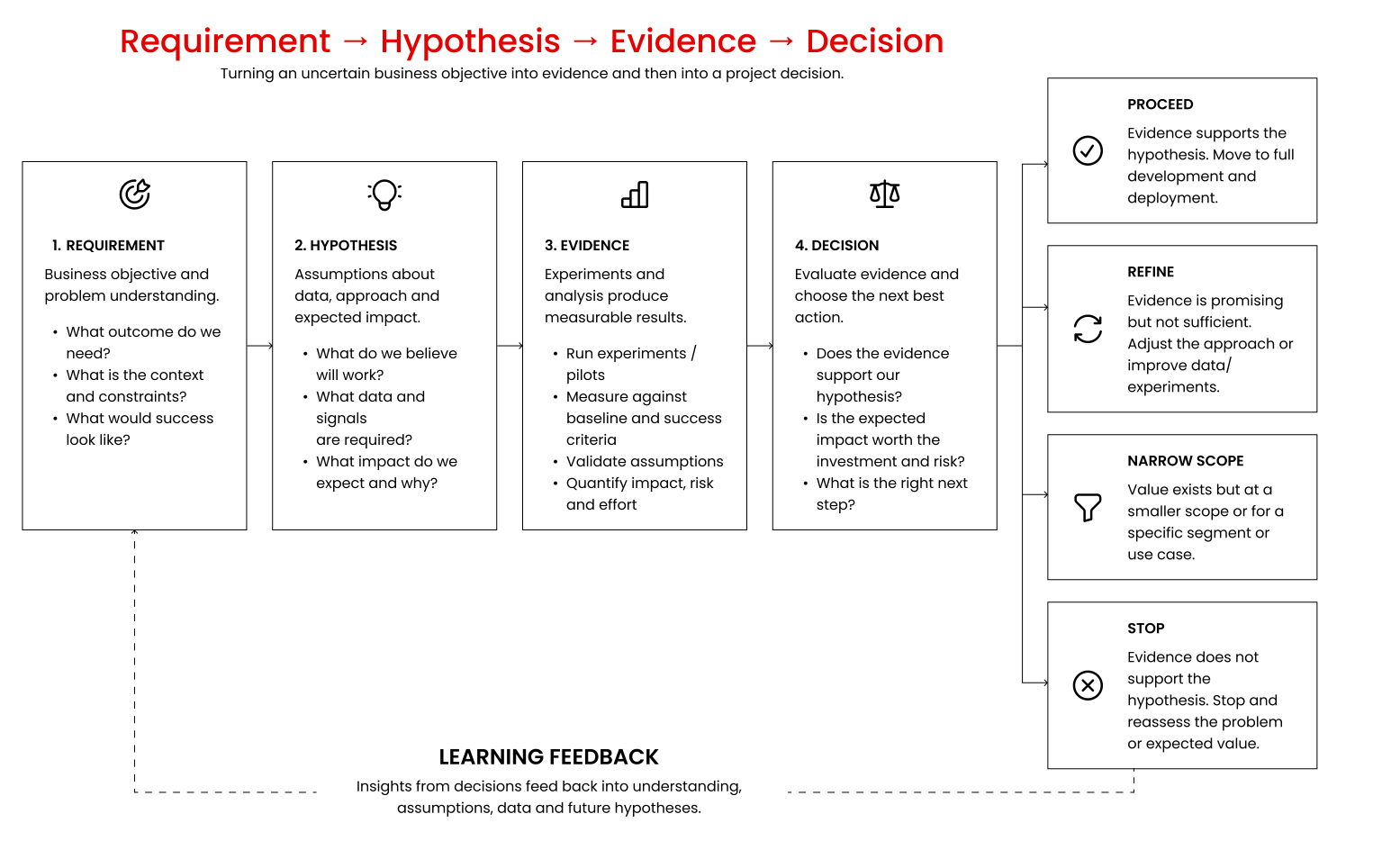
Figure 1: Turning an uncertain business objective into evidence and then into a project decision.
Feasibility Beyond the Technology
In a conventional software project, technical feasibility is often assessed in terms of architecture, technology, integration, performance, security and development capacity. AI projects require those assessments as well, but they add another dimension. We need to think about whether the available data and operating environment can support the intended AI capability.
We therefore assess data readiness as an early project dependency rather than leaving it entirely to the implementation phase. Questions may include:
- Are the necessary data available and accessible?
- Are they representative of the conditions in which the system will operate?
- Are labels or target variables sufficiently reliable?
- Are historical records long enough to capture relevant events?
- Are different data sources consistent and correctly aligned?
- Are there privacy, security or governance restrictions that affect their use?
- Are rare events represented sufficiently to evaluate the intended capability?
- Can the organization continue to collect the data required after deployment?
A project can have an experienced AI team, sufficient infrastructure and a strong business case and still fail because the data cannot support the required capability. For this reason, data readiness is not merely a technical workstream. It is part of project feasibility.
Another practice we consider important is establishing a baseline before investing heavily in model complexity. The baseline may be an existing business rule, a statistical method, a simple machine learning model or the current manual process. Its purpose is not necessarily to become the final solution - it provides a reference point.
Without a baseline, a project can spend considerable effort improving a model without knowing whether the improvement is meaningful in business terms. For example, a predictive-maintenance initiative may compare a machine learning model with the organization’s existing maintenance schedule or threshold-based alarms. A document processing project may compare a multimodal model with a conventional OCR and rules-based pipeline.
The question is not simply whether the AI model performs well. The question is whether the proposed AI capability provides sufficient improvement over a credible alternative to justify its cost, complexity and operational risk. As a rule, we do not replace human judgment or an existing solution with AI unless it is demonstrably more cost-effective. Adopting AI for its own sake is not a justification.
AI systems are frequently evaluated statistically. That creates another difference in project management. A conventional software test can often establish whether a defined function behaves as expected for a given input. AI evaluation usually asks how often a system produces an acceptable result under defined conditions.
This means that a model can have impressive technical metrics and still be unsuitable for the business process. Accuracy, precision, recall, F1 score, ROC-AUC, calibration, latency or other metrics may all be relevant, but none of them, by itself, defines business value. It is also worth remembering that machine learning systems are inherently probabilistic. They will never reach 100% accuracy or perfect repeatability. Where that level of certainty is required, we choose deterministic, rule-based approaches instead.
We therefore define evaluation around the decision the system is intended to support. For a fraud detection system, false positives may create unnecessary investigations while false negatives represent financial loss. For predictive maintenance, a missed failure may be far more costly than an additional inspection. For document extraction, an incorrect value in a payment field may have a different risk from an incorrect value in a descriptive field. The project needs acceptance criteria that reflect those differences, so AI model evaluation becomes meaningful when technical performance is connected to the consequences of being wrong.
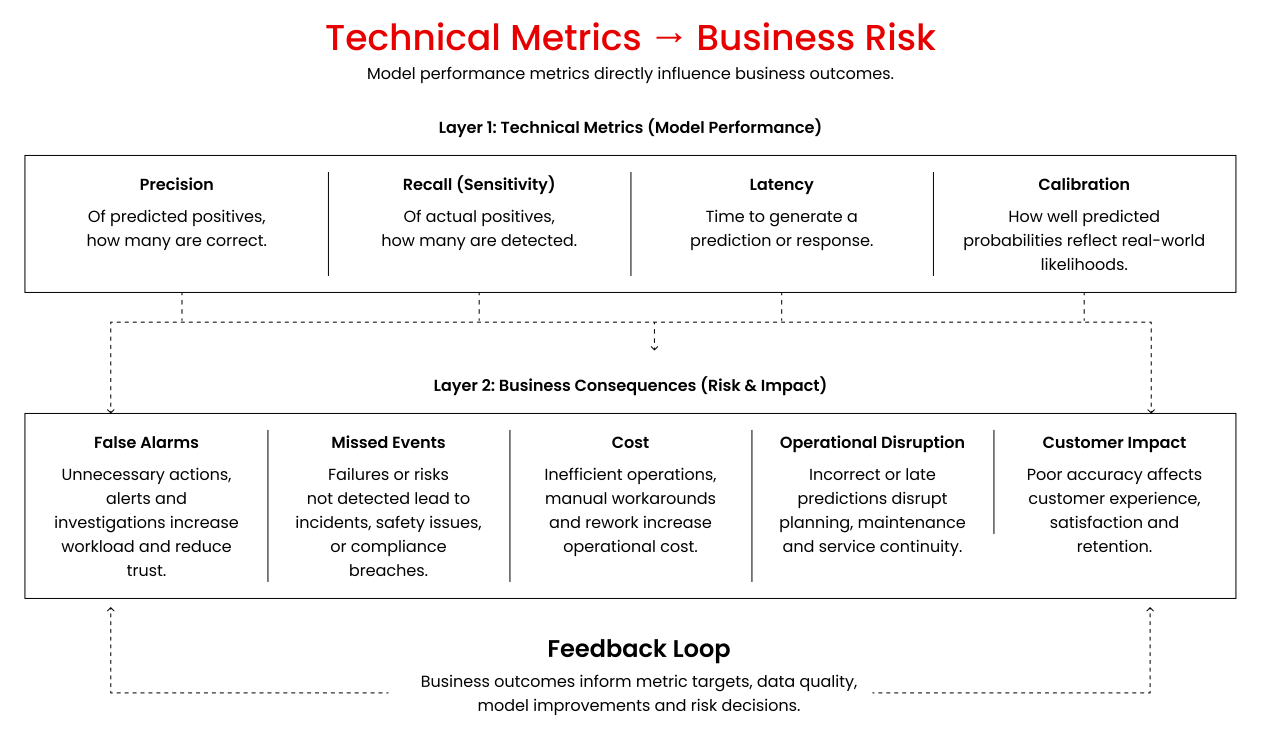
Figure 2: Technical metrics only matter once they are connected to what being wrong actually costs the business.
Generalization Must Be Planned, Not Assumed
A model is not valuable because it performs well on the data used during development. It is valuable because it performs sufficiently well on new data and under the conditions in which it will actually operate. This is the problem of generalization. We therefore need to consider not only whether a model works on a test set, but whether the test conditions represent the production environment.
In enterprise systems, the environment can change. User behavior changes. Suppliers change document layouts. Equipment is replaced or recalibrated. Market conditions move. Business processes evolve. Data sources change. A model can therefore deteriorate without any change to the application code. That is why we need to think about data and concept drift.
For AI systems, deployment is consequently not the end of the project lifecycle. It is the transition into an operational phase in which performance, data and business outcomes need to be monitored. Deployment is a milestone. It is not the end of the AI lifecycle.
Iteration Has a Different Purpose
Good software engineering has always been iterative. Agile development did not invent iteration, and AI projects do not have a monopoly on experimentation. The important difference is what the iteration is trying to establish.
In conventional software development, iteration often improves the implementation of a known requirement. In AI development, iteration may determine whether the requirement itself is technically achievable, whether the data are sufficient, which approach is appropriate or whether the business objective needs to be reconsidered.
That work follows its own discipline, starting with the business objective the system is meant to serve, then moving through a realistic assessment of the data available, a baseline to measure against, and a round of experimentation. Each result is evaluated against that baseline and the original objective, which is what drives the decision to refine the approach or move it toward operationalization. Even then, the work is not done - a deployed model still depends on ongoing monitoring, since nothing guarantees its performance holds once the data behind it starts to shift.
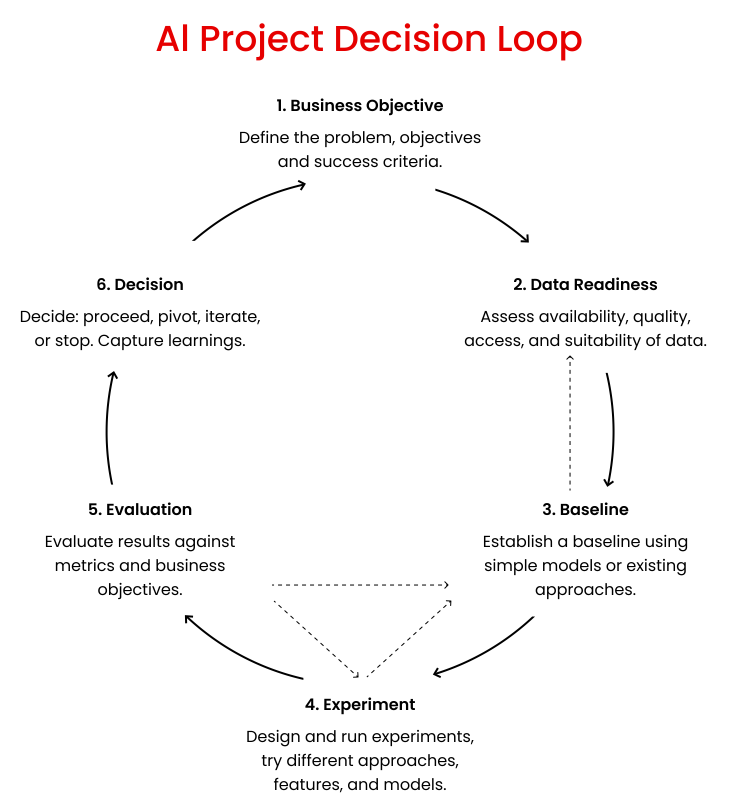
Figure 3: AI project decision loop.
This sequence is not necessarily linear. Evaluation may send the team back to data preparation. A weak baseline may lead to a new hypothesis. A model that performs well technically may expose an operational problem. Production monitoring may reveal a change in data distribution that requires another experiment. We do not regard this movement backward as a loss of control. The objective of disciplined iteration is to make uncertainty visible early enough to influence the next project decision.
Different Risk Profile and Where Agile Stops
AI projects contain the risks found in software projects like unclear requirements, changing scope, integration problems, security, infrastructure, technical debt, capacity, schedule and budget. They also introduce risks that are specific to AI projects and require explicit treatment:
- Insufficient or unrepresentative data;
- Poor data quality or unreliable labels;
- Uncertain model performance;
- Data and concept drift;
- Model selection risk;
- False positives and false negatives;
- Lack of explainability where it matters to the decision;
- Hallucination and unsupported output in generative AI systems;
- Dependency on foundation models or third-party AI services;
- Variable inference cost and latency;
- Evaluation uncertainty;
- Governance, privacy, audit and regulatory requirements.
This does not mean that every AI project is inherently more difficult than every software project. It means that the uncertainty has a different shape. When uncertainty changes, the project controls must change with it.
This is where we need to be precise about Agile. We use Agile practices where they improve delivery. Short iterations, cross-functional teams, frequent feedback, visible backlogs and incremental delivery are valuable in AI projects. But Agile does not answer every AI-specific project question.
A sprint can organize an experiment. It cannot guarantee that the experiment will demonstrate the required performance. A backlog can contain data-preparation tasks. It cannot guarantee that the available data are sufficient. A Definition of Done can specify that a model has been evaluated. It cannot determine whether the evaluation metric represents the actual business risk. Agile is therefore a valuable way to organize and deliver work. It is not, by itself, a complete AI project lifecycle.
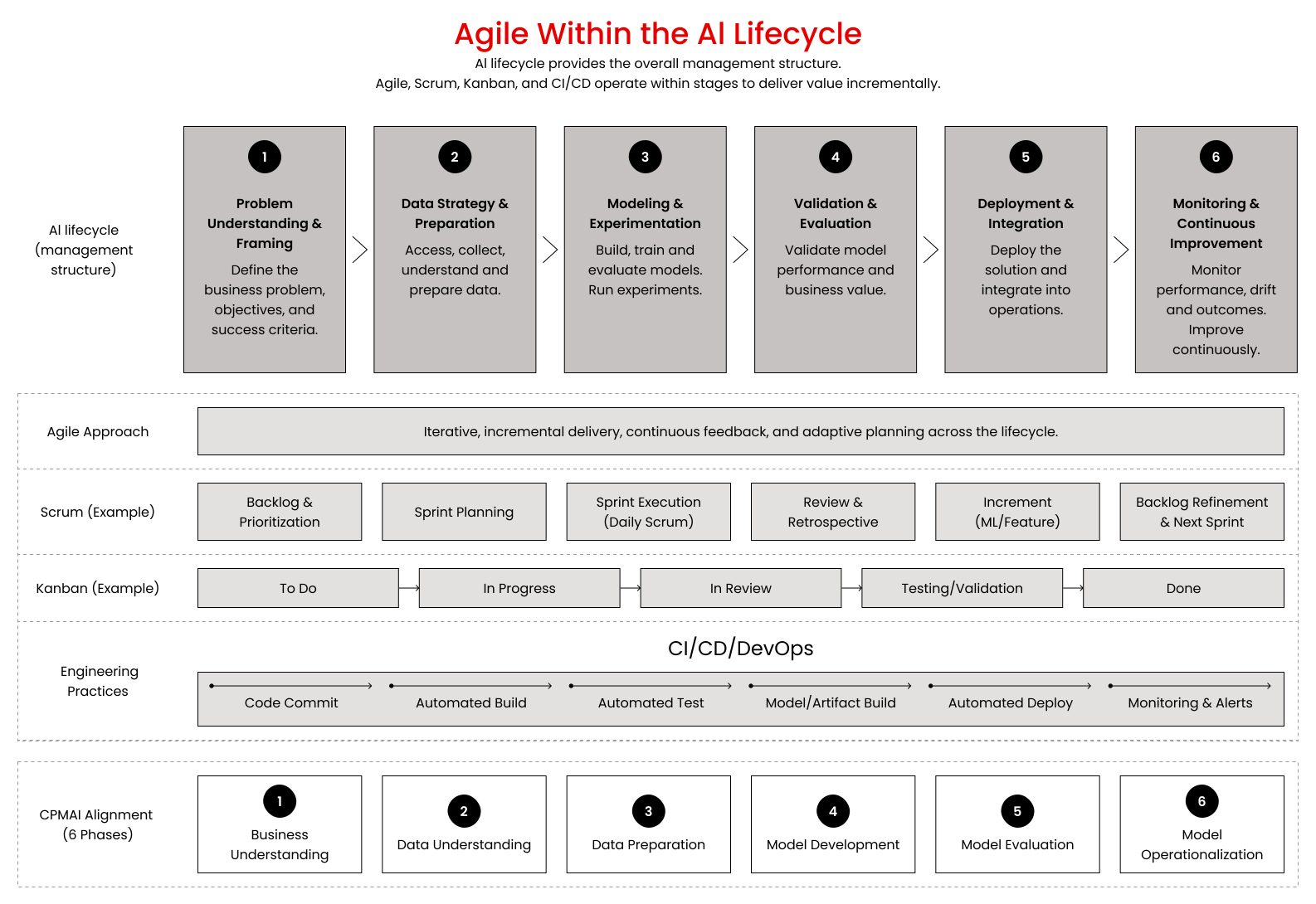
Figure 4: Agile organizes delivery within each stage of the AI lifecycle. It does not, by itself, manage the uncertainty that is specific to AI.
We combine Agile delivery practices with explicit management of data readiness, experimentation, evaluation, operational constraints and ongoing performance. Agile manages the iteration but AI project management must also manage the uncertainty.
What This Means for the Project Manager
The project manager in an AI initiative therefore has a broader responsibility than simply coordinating development tasks. The role includes creating the conditions in which technical uncertainty can be converted into evidence and evidence into decisions. That requires active coordination among business owners, domain specialists, data owners, data scientists, AI and software engineers, security and governance functions, operations teams and end users. It also requires project controls that make uncertainty visible rather than hiding it behind optimistic estimates.
We do not expect every AI initiative to follow the same technical path. We do expect the project to make its assumptions explicit, test the assumptions that matter, measure the results against meaningful criteria and make deliberate decisions about whether to continue, change direction or stop. That is the practical difference between managing an AI project and managing software development that happens to contain an AI component.
From Difference to Lifecycle
Understanding AI before managing AI projects established why an AI project should not be treated simply as a software development project. This article has taken the next step - the difference changes how we deal with feasibility, requirements, experiments, data, evaluation, risk, iteration and operationalization. The natural next question is how these practices fit together into a coherent project lifecycle.
AI project management did not appear in isolation. It evolved from established software and project-management practices, data science approaches and operational disciplines, while adding mechanisms for managing the uncertainty that is specific to AI.
Further reading
- Leading & Managing AI Projects Digital Guide, PMI
- Martin Zinkevich, Rules of Machine Learning: Best Practices for ML Engineering, Google
- What is data drift in ML, Evidently AI, January 2025
- Artificial Intelligence Risk Management Framework, NIST
Red Black Tree delivers AI systems from feasibility to operation, under the project discipline described here. Get in touch to talk about your next AI initiative.
Frequently asked questions
How does planning an AI project differ from traditional software scope definition?
Traditional software planning decomposes known functional requirements into actionable development tasks. AI projects require an additional layer - defining hypotheses about what can be achieved, establishing data readiness, and designing time-boxed experiments to gather evidence before committing to full-scale development. An AI project lifecycle is iterative and non-linear, often requiring backward and forward movements across phases as new evidence emerges.
Why isn't Agile/Scrum sufficient on its own for managing an AI project?
Agile manages delivery iterations and team workflows, but it cannot answer AI-specific questions regarding model feasibility, statistical uncertainty, or data representativeness. A sprint can structure an experiment, but it cannot guarantee that the model will achieve the necessary business threshold.
What role does establishing a baseline play in AI risk management?
A baseline (e.g., existing business rules, simple statistical models, or current manual workflows) provides a benchmark to judge whether an AI approach is demonstrably better. Without a baseline, teams risk over-engineering complex models that increase operational costs and risks without delivering meaningful business value. Baseline models help teams understand which parameters truly influence business requirements while validating decisions against domain expertise.
- ai
- project-management
- experimentation
- data-readiness
Senior AI Architect
Dejan Vujić, PhD EE, is a Senior AI Architect at Red Black Tree, a PMI-CPMAI-certified professional and a member of IIBA and IAPP, focused on enterprise AI project delivery, AI governance and operational AI systems.