Understanding AI before managing AI projects
AI project management / Part 1 of 5

Senior AI Architect
- Published
- Reading time
- 10 min read
AI systems learn or infer their behavior from data, so the requirement cannot be fully specified in advance and data becomes the first constraint. This opener separates AI from machine learning, introduces the seven AI patterns as a business lens, and shows why most projects stall before the modeling stage, using industrial predictive maintenance as the running example.
Overview
AI projects are becoming increasingly common in enterprise environments. For technology companies with a traditional software development background, this means that projects are moving beyond conventional software systems toward solutions whose behavior is learned, inferred, or generated from data.
This transition brings a different set of challenges for project managers. Managing an AI project is not simply the same as managing a conventional software project with a different technology stack. The difference is not mainly about programming languages, frameworks, or infrastructure; it is about the nature of the systems being built, the central role of data, the need for experimentation, and the fact that the final behavior of an AI system often cannot be fully specified in advance.
Understanding this difference is an important first step toward managing AI projects effectively.
Two Kick-off Meetings
Imagine two project kick-offs.
In the first, a team is building a customer portal. The requirements can be written clearly in advance - users log in, forms validate, data is retrieved, and the interface behaves according to explicit rules. The work may be complex, but the intended behavior of the system can largely be specified before development begins.
In the second, a team is building an AI system for predictive maintenance of industrial equipment. The goal is to analyze operating history, usage hours, maintenance records, and sensor readings such as vibration, temperature, pressure, sound (noise) or power consumption in order to identify patterns that indicate degradation or an increased risk of failure. At that point, the team is not only implementing software. It is also trying to determine whether the target behavior is technically achievable given the available data and sensor signals, the rarity of actual failure events, the selected modeling approach, and the acceptable balance between missed failures and false alarms.
In many enterprise AI initiatives, the model is not the first constraint. Data access, data ownership, sensor quality, historical maintenance records, and operational responsibility often become critical earlier than model selection. A technically promising idea can therefore stall long before the team reaches the modeling stage.
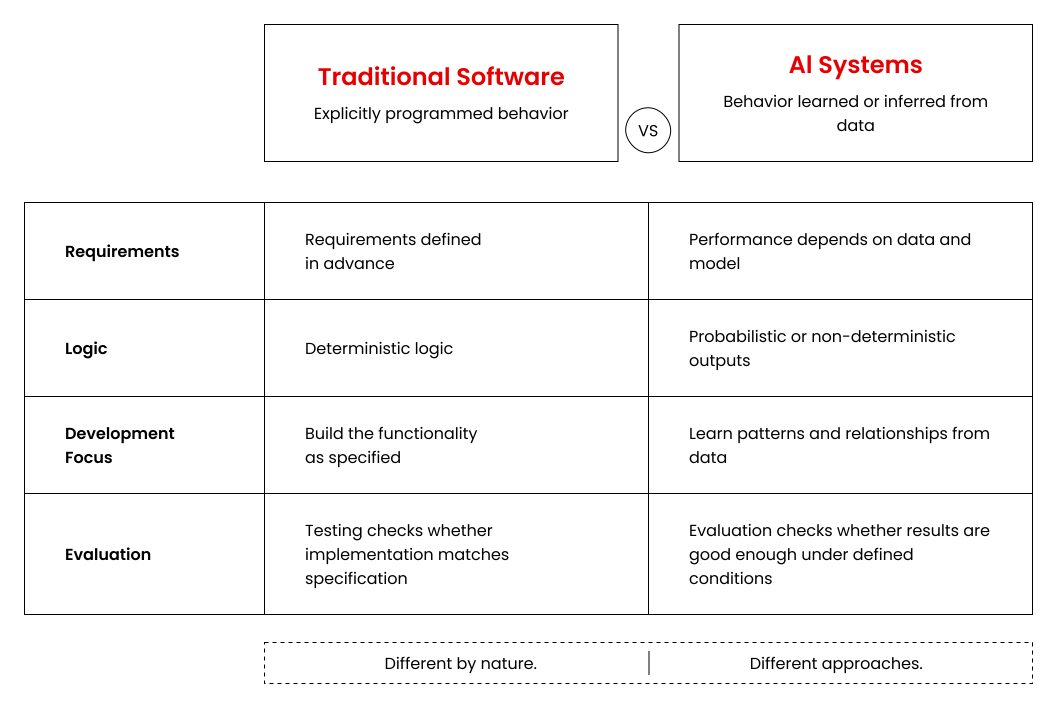
Figure 1: Traditional software and AI systems differ in how behavior is defined, developed, tested, and evaluated.
What We Mean by Artificial Intelligence
Artificial Intelligence is widely used as a term, but it does not have one universally accepted definition. For the purposes of this discussion, AI can be viewed as a broad field that enables machines to perform tasks that, when performed by humans, involve some form of intelligence. Depending on the problem, this may include recognizing patterns, understanding language, predicting outcomes, learning from data, making decisions, planning actions, adapting to experience, or interacting naturally with people.
When an organization says, “we want to implement AI,” that statement alone says very little. It is like saying, “I want to take a trip somewhere,” without saying where or why or when.
A predictive maintenance system, a fraud-detection system, a demand-forecasting model, an LLM-based assistant, and an autonomous (intelligent) robot may all fall under AI, but they are fundamentally different kinds of systems with different risks, data needs, evaluation methods, and operating models.
AI Is Not the Same as Machine Learning
One of the most common sources of confusion is the tendency to use Artificial Intelligence and Machine Learning as if they were interchangeable. They are not.
AI is the broader field. Machine Learning is one of the principal approaches used within that field. Machine Learning enables systems to learn patterns from data and use those patterns to make predictions, classifications, or decisions. Deep Learning is an important family of Machine Learning methods based on deep neural networks.
More recently, Generative AI and Large Language Models have brought AI into mainstream business discussions. They are important technologies, but they should not be confused with the broader field of AI itself.
This distinction matters in project management. The first question in an AI initiative should not be, “Which AI technology should be used?” The first question should be, “What business problem are we trying to solve, and what type of AI capability would actually solve it?” Only after that, it makes sense to discuss models, architecture, data pipelines, or vendors. A business problem may require several models or technologies rather than a single AI solution.
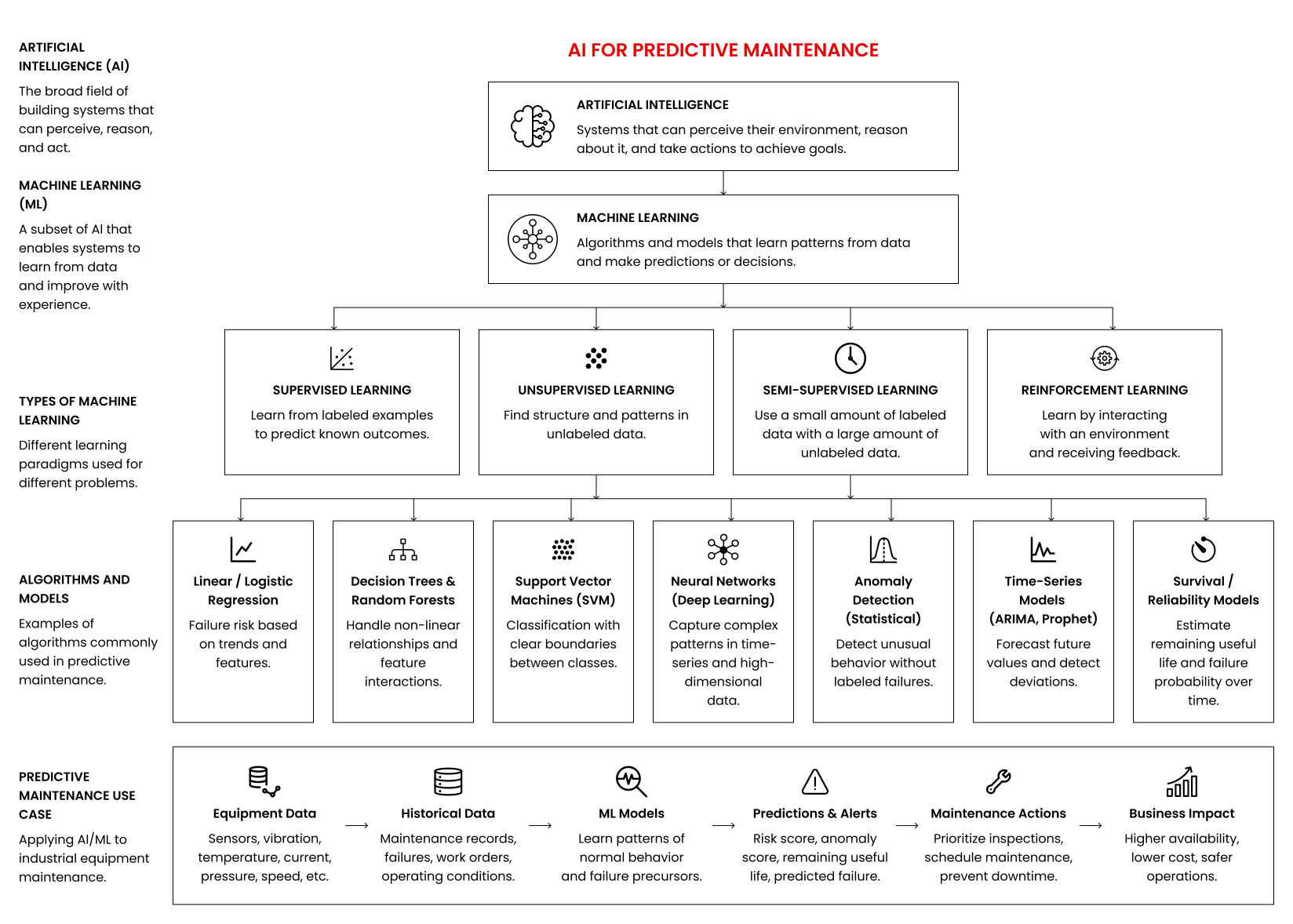
Figure 2: AI as a field, Machine Learning as an approach, and selected techniques applied to predictive maintenance.
Why AI Matters Now
AI is not new. What is new is the scale of the environment in which it can now be developed and deployed. IDC forecast global data volumes to almost quadruple between 2019 and 2025, the cost of GPT-3.5-level inference dropped more than 280-fold between late 2022 and late 2024, and by most industry surveys close to nine in ten organizations now use AI somewhere in the business. What has not kept pace is turning that adoption into results. Most of those same organizations are still running pilots, not production systems, and only a small fraction report a significant bottom-line impact. That gap between adoption and impact is precisely where we spend most of our time with clients, and it is rarely a modeling problem.
This is important when organizations consider an AI strategy. The current interest in AI is not the result of a single invention. It is the result of decades of research meeting scalable infrastructure, large datasets, and the ability to integrate AI capabilities into existing business, technology and (partially) regulatory environments.
Predictive maintenance is a good example of this convergence. Modern industrial AI systems can combine historical maintenance logs, ERP or operational records, and real-time sensor data to forecast potential equipment issues earlier than fixed maintenance schedules alone.
A model that raises an alert for every possible failure may look impressive in a dashboard. A maintenance manager may see it differently if those alerts create unnecessary inspections, spare-parts orders or production interruptions. In industrial AI, the objective is not simply to predict more events - it is to make earlier and better maintenance decisions at an acceptable operational cost.
A More Useful Business View: AI Patterns
From a project-management perspective, classifying AI only by algorithms is often not the most useful approach. A more practical lens is to classify AI by the type of problem it is intended to solve.
A simple business-oriented way to think about AI projects is through recurring patterns such as those described by PMI and Cognilytica:
- Hyperpersonalization;
- Patterns and Anomalies;
- Conversational / Human Interaction;
- Predictive Analytics and Decision Support;
- Goal-Driven Systems;
- Autonomous Systems;
- Recognition.
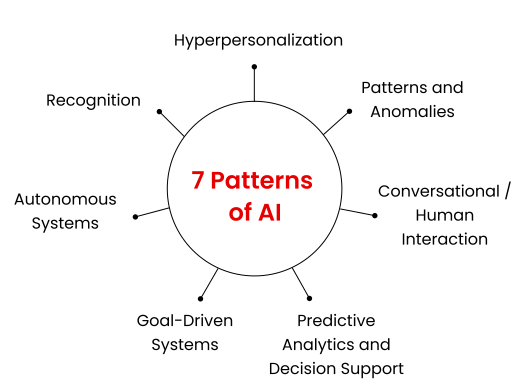
Figure 3: The Seven Patterns of AI provide a business-oriented way to classify recurring AI capabilities.
The practical benefit is that project sponsors and project managers can move away from vague statements such as “we want AI” and define the capability the project is expected to deliver. A predictive maintenance system, for example, is not the same kind of project as a conversational assistant or a recognition system, even if all of them are described as AI.
In practice, we rarely see a project that fits neatly into a single pattern. A predictive maintenance initiative, for example, almost always blends Patterns and Anomalies with Predictive Analytics and Decision Support, and increasingly a Conversational / Human Interaction layer for the maintenance team itself. We treat the seven patterns as a working lens, not a box a project has to fit into. Forcing a single label can be as misleading as refusing to classify at all. What actually matters is not which label wins, but that the exercise forces the right conversation early about what is this system meant to do, and what does that imply for data, evaluation, and risk. That conversation, more than the label, is where a structured approach earns its keep on a project.
Patterns Describe the Goal and Technology Describes the Method
A pattern describes what the system is meant to accomplish. Technology describes how the team will attempt to accomplish it.
For example, a predictive maintenance solution may combine anomaly detection, time-series models, classification models, sensor data pipelines, maintenance records and operational dashboards. In a more advanced setup, it may also include an AI agent or natural-language interface that helps maintenance engineers query equipment status or investigate alerts using enterprise knowledge and model outputs. The same technology can therefore appear in several different AI patterns.
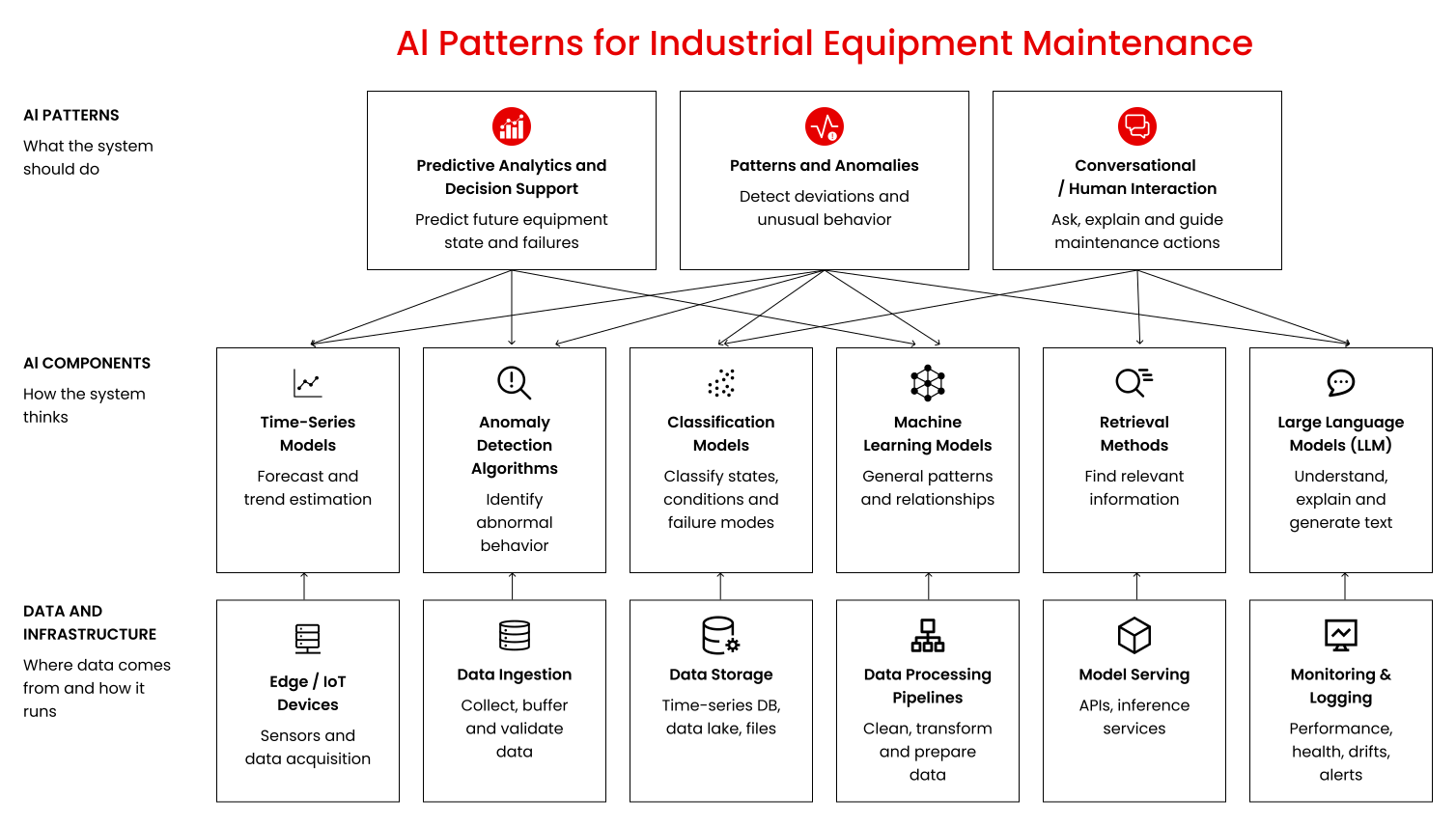
Figure 4: One AI pattern can use several technologies, while one technology can support multiple AI patterns. Predictive maintenance use case.
Simply calling something an “AI project” is not enough for serious planning. The project manager needs to understand what type of AI capability is being built, what data it depends on, how performance will be evaluated, what level of uncertainty exists, and what would make the solution production-ready.
Why This Matters for Project Management
If AI systems are developed differently from conventional software systems, can they really be managed in the same way? The key difference is that traditional software primarily implements explicitly programmed behavior, while AI systems often learn, infer, rank, recommend, or generate behavior from data. This difference affects how AI projects need to be planned, developed, evaluated, and ultimately brought into production. Understanding it is the starting point for a more AI-aware approach to project management.
From our experience, most AI projects do not fail because the team selected the wrong model. They fail because data, evaluation, integration, operational ownership, and ongoing monitoring are treated as details to solve later. By the time those issues become visible, the project may already have accumulated significant technical, financial, and organizational risk. In practice, the project often does not fail in the modeling phase. It fails earlier when nobody has taken ownership of the data question. Understanding these fundamental differences is the first step. The next challenge is learning how to structure planning, estimation, and control when dealing with data uncertainty and experimentation.
Further reading
- PMI overview of CPMAI and managing AI initiatives
- CRISP-DM guide for data-centric lifecycle thinking
- NIST framework for trustworthy AI risk management
- MLOps overview of continuous integration, delivery, and training for ML systems
- Prashant Dhingra: Predictive maintenance process and data considerations, October 2018
- Vicente Segura, Yvonne Rene de Cotret: Using AI in predictive maintenance to forecast the future - The value of machine learning in predictive maintenance, February 2025
- AI-based predictive maintenance overview
- Artificial Intelligence Index Report 2025, Stanford HAI
- The State of AI: Global Survey 2025, McKinsey
- Data Age 2025, IDC, sponsored by Seagate
- Lack of AI-Ready Data Puts AI Projects at Risk, Gartner, February 2025
- Gregory Vial, Jinglu Jiang, Tanya Giannelia, and Ann-Frances Cameron: The Data Problem Stalling AI, MIT Sloan Management Review, Winter 2021
Red Black Tree delivers AI systems from feasibility to operation, under the project discipline described here. Get in touch to talk about your next AI initiative.
Frequently asked questions
Why does traditional software project management fail for AI projects?
Traditional software development relies on predefined requirements and deterministic logic. AI projects introduce probability, heavy reliance on data quality and availability, and the need for continuous experimentation. As a result, project control shifts from delivering against fixed feature lists to systematically validating hypotheses.
When does the distinction between AI and Machine Learning matter for project managers?
It becomes critical during the problem definition phase. AI is the overarching capability, while ML is a specific approach that learns patterns from data. By framing the initiative around the core business problem (e.g., predictive analytics or pattern detection), you choose the technical approach based on data readiness and risk rather than forcing a specific technology upfront. Business requirement is the driver and AI and ML are support.
What is the root cause of most enterprise AI project failures?
AI projects rarely fail during model selection. They stall due to poor data preparation, lack of clear data ownership, neglecting operational integration, or failing to evaluate technical metrics against real-world business risks. Unfortunately, with poor project management, failure is visible only when the model is selected and deployed, which is far beyond initial phases and after significant effort investment.
- ai
- project-management
- predictive-maintenance
- cpmai
Senior AI Architect
Dejan Vujić, PhD EE, is a Senior AI Architect at Red Black Tree, a PMI-CPMAI-certified professional and a member of IIBA and IAPP, focused on enterprise AI project delivery, AI governance and operational AI systems.